
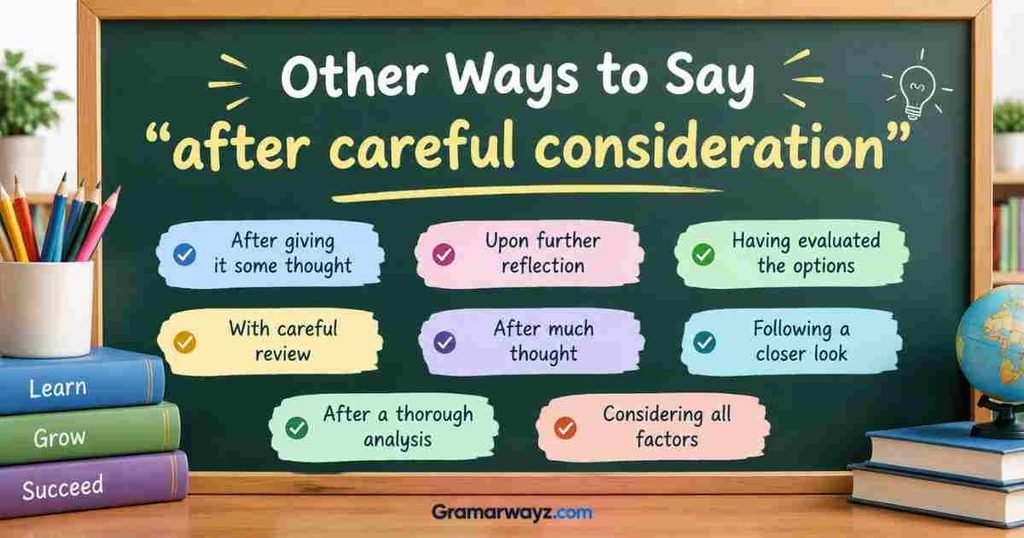

Choosing the right words after making a decision can help you communicate with confidence, clarity, and professionalism. If you frequently use “after careful consideration” in business emails, formal letters, official statements, or everyday conversations, exploring other ways to say this phrase can make your writing more natural and engaging.
There are many professional alternatives, formal expressions, conversational phrases, and synonyms that convey thoughtful deliberation, serious reflection, and a well-considered decision without sounding repetitive. Expressions such as “after thoughtful review,” “having weighed the options,” and “after giving it careful thought” communicate a similar meaning while maintaining an appropriate tone.
Whether you are accepting an offer, declining a proposal, evaluating options, or sharing a final decision, the right wording helps you express sincerity, demonstrate sound judgment, and ensure clear communication. In this guide, you’ll discover useful language alternatives, practical examples, and best practices for choosing thoughtful expressions that suit your audience, purpose, and communication style.
What Does “After Careful Consideration” Mean?
“After careful consideration” means taking enough time to think about a situation, review the available options, and make a thoughtful decision. It suggests that someone has evaluated important details before reaching a conclusion. This phrase is commonly used in professional emails, business letters, job applications, and formal conversations.
For example, you might write, “After careful consideration, we have decided to decline the offer.” This sentence communicates that the decision was made thoughtfully rather than impulsively. Similar expressions include “after thoughtful review,” “having weighed the options,” and “after giving it careful thought.” Choosing the right alternative depends on your audience, writing style, and the message you want to convey.
When Should You Use “After Careful Consideration”?
The phrase “after careful consideration” is useful when you want to communicate that a decision was made after thoughtful evaluation. It works particularly well in professional and formal situations where clarity, respect, and a polite tone matter.
You can use it in situations such as:
- Professional emails: Explaining a decision to a colleague, client, or business partner.
- Job offers: Accepting or declining an employment opportunity politely.
- Business proposals: Communicating a decision after reviewing the terms.
- Formal letters: Explaining the reasoning behind an important conclusion.
- Personal decisions: Sharing a thoughtful choice with friends or family.
For casual conversations, alternatives such as “after thinking it over” or “after giving it some thought” may sound more natural. Selecting an expression that matches the situation helps your message feel clear, appropriate, and genuine.
Read More: Another Word for Similar
Is “After Careful Consideration” Professional and Polite?
Yes, “after careful consideration” is a professional and polite expression. It shows that you have taken time to evaluate a matter before making a decision. This makes it suitable for workplace communication, business correspondence, formal announcements, and sensitive discussions.
For example, “After careful consideration, we have decided to move forward with another candidate” is a respectful way to communicate a hiring decision. However, using the same phrase repeatedly can make your writing sound predictable or overly formal.
Depending on the context, you can replace it with expressions such as “after reviewing all the details,” “having carefully evaluated the options,” or “after thoughtful deliberation.” These alternatives maintain a professional tone while adding variety to your writing.
Why “After Careful Consideration” Sounds Overused
Although “after careful consideration” is clear and professional, it can sound repetitive when used in multiple emails, letters, or business documents. Because the phrase frequently appears in rejection messages, formal decisions, and corporate communication, readers may recognize it as a standard expression rather than a personal or engaging choice.
Using alternatives can make your writing feel more natural without changing the intended meaning. For example, “after weighing the options” emphasizes comparing different possibilities, while “after giving it some thought” sounds more conversational. Similarly, “following a thorough review” works well when discussing reports, proposals, or applications.
The key is to choose wording that fits your purpose, audience, and tone. Varying your expressions helps keep professional communication clear, respectful, and less repetitive.
The Most Useful Alternatives to “After Careful Consideration”
1. After Thorough Review
“After thorough review” is a professional alternative to “after careful consideration” that emphasizes examining information in detail before making a decision. It is commonly used in business emails, official documents, and workplace communication.
- “After thorough review, we have decided to approve your proposal.”
- “After thorough review, the committee selected the most qualified candidate.”
In the first example, the proposal was examined before approval. In the second, the committee reviewed the candidates before making its final choice. This phrase works well when a decision depends on documents, applications, or detailed information.
2. Following Careful Review
“Following careful review” communicates that someone has examined the relevant details before reaching a conclusion. It sounds formal and polished, making it suitable for professional emails, business letters, and official announcements.
- “Following careful review, we have accepted your application.”
- “Following careful review, the management team decided to update the company policy.”
The first example shows that the application was evaluated before acceptance. The second indicates that management examined the existing policy before deciding to make changes. This expression helps explain the reasoning behind a professional decision.
3. After Much Thought
“After much thought” is a natural alternative that emphasizes personal reflection rather than a formal review process. It is especially useful when discussing career choices, relationships, important opportunities, or other meaningful decisions.
- “After much thought, I have decided to accept the new job offer.”
- “After much thought, she realized that changing careers was the right decision.”
The first example communicates a carefully considered career choice. The second shows that the person spent time reflecting before deciding to make a change. This phrase sounds more personal and conversational than many formal alternatives.
4. After Thoughtful Evaluation
“After thoughtful evaluation” means assessing different options, circumstances, or outcomes before making a decision. It is useful in professional and academic writing when the decision involves comparing possibilities and determining the most suitable option.
- “After thoughtful evaluation, we selected the supplier that offered the best value.”
- “After thoughtful evaluation, the school introduced a new learning program.”
In the first example, the team compared suppliers before choosing one. In the second, the school considered its options before introducing the program. This expression highlights the importance of weighing alternatives before reaching a conclusion.
Read More: Another Word for Skills
5. Upon Careful Assessment
“Upon careful assessment” is a formal expression that emphasizes evaluating a situation, identifying important factors, and determining the most appropriate course of action. It is commonly used in business, recruitment, education, and administrative communication.
- “Upon careful assessment, the team determined that the project was financially viable.”
- “Upon careful assessment of your application, we found that additional documents were needed.”
The first example shows that the team evaluated the project’s financial potential. The second explains that the application was examined before requesting more information. This phrase is particularly useful when a decision depends on suitability, requirements, or performance.
6. After Meticulous Analysis
“After meticulous analysis” emphasizes an extremely detailed examination of information, facts, or evidence. It is a strong alternative to “after careful consideration” when discussing research, financial decisions, technical findings, or complex problems.
- “After meticulous analysis of the sales data, the company adjusted its pricing strategy.”
- “After meticulous analysis of the research findings, the scientists identified a promising pattern.”
The first example connects a business decision to a detailed study of sales figures. The second highlights the careful examination of research results. This phrase conveys precision and attention to detail.
7. Following Extensive Deliberation
“Following extensive deliberation” suggests that a decision was reached after considerable discussion and reflection. It is especially appropriate for committees, boards, leadership teams, and organizations making important decisions.
- “Following extensive deliberation, the board approved the proposed expansion.”
- “Following extensive deliberation, the panel announced its final recommendation.”
In the first example, board members discussed the proposal before approving it. In the second, the panel considered different viewpoints before announcing its recommendation. This expression is particularly effective when several people participate in the decision-making process.
8. Upon Close Examination
“Upon close examination” means studying something carefully to understand its details, identify problems, or uncover important information. It works well when a decision depends on inspecting evidence rather than simply thinking about the available options.
- “Upon close examination, we discovered several errors in the original report.”
- “Upon close examination of the proposal, the team identified a more affordable solution.”
The first example shows how careful inspection revealed mistakes. The second demonstrates that examining a proposal in detail helped the team find a better option. This phrase is useful for reports, documents, evidence, and project assessments.
9. After Thoughtful Assessment
“After thoughtful assessment” communicates that someone has evaluated a situation carefully before deciding what to do. It combines logical judgment with reflection, making it suitable for both professional decisions and personal choices.
- “After thoughtful assessment, we decided to extend the project deadline.”
- “After thoughtful assessment of my priorities, I chose to pursue further education.”
In the first example, the decision reflects an evaluation of the project’s needs. In the second, the speaker considered personal goals before choosing an educational path. This expression helps communicate that a decision was based on relevant circumstances and priorities.
10. After Pondering Deeply
“After pondering deeply” is a reflective expression that emphasizes spending considerable time thinking about an important or difficult subject. It sounds more personal and expressive than “after careful consideration” and is suitable for reflective writing and personal messages.
- “After pondering deeply, I realized that changing careers was the right choice.”
- “After pondering deeply over the offer, she decided to accept the position.”
The first example highlights personal reflection about a major life decision. The second shows that the person took time to consider an opportunity before responding. In everyday professional communication, “after giving it considerable thought” may sound more natural.
11. After Reviewing the Matter
“After reviewing the matter” is a straightforward, professional alternative that indicates someone has examined a particular issue before making a decision. It is often used in customer service responses, workplace emails, business correspondence, and formal discussions.
- “After reviewing the matter, we have decided to issue a full refund.”
- “After reviewing the matter, the manager agreed to reconsider the employee’s request.”
The first example explains a customer service decision made after examining a concern. The second shows that the manager reviewed the situation before agreeing to reconsider the request. This phrase maintains a neutral and respectful tone.
12. With Due Consideration
“With due consideration” is a formal expression that suggests a matter has received appropriate attention and thought. It is suitable for official documents, business correspondence, and situations where fairness and responsibility are important.
- “With due consideration of the available evidence, the committee reached its final decision.”
- “Your request has been reviewed with due consideration of the company’s policies.”
In the first example, the committee considered the evidence before reaching a conclusion. In the second, the request was evaluated according to the relevant policies. This phrase emphasizes fairness and careful judgment in formal communication.
13. Upon Thoughtful Review
“Upon thoughtful review” means examining information carefully while considering its meaning and possible implications. It is a useful alternative for professional emails, academic writing, and situations where both reviewing details and reflecting on them are important.
- “Upon thoughtful review, we decided to revise the proposal before submitting it.”
- “Upon thoughtful review of the feedback, the team introduced several improvements.”
The first example shows that the proposal was reconsidered before submission. The second explains how reviewing feedback helped the team improve its work. This expression sounds professional without being overly technical.
Learn More: Other Ways to Say “Ash” (Synonyms and Alternatives)
14. After Deliberate Reflection
“After deliberate reflection” means intentionally spending time thinking about a situation, evaluating its significance, and considering possible outcomes. It works well in personal statements, professional discussions, and writing about meaningful decisions.
- “After deliberate reflection, I decided to focus on my long-term career goals.”
- “After deliberate reflection, the organization revised its approach to employee development.”
The first example highlights a personal decision based on future priorities. The second indicates that the organization reconsidered its strategy before making changes. This phrase emphasizes intentional thinking rather than a quick or impulsive response.
15. After Thoughtful Review
“After thoughtful review” is a versatile expression that combines examining information with considering its implications. It is appropriate for business correspondence, academic work, project planning, and situations where a decision requires careful judgment.
- “After thoughtful review, we selected the proposal that best met our objectives.”
- “After thoughtful review of the feedback, I revised my original recommendation.”
In the first example, the proposal was chosen according to specific goals. In the second, the writer considered feedback before changing the recommendation. This phrase helps communicate a considered decision in clear, professional language.
16. Upon Further Consideration
“Upon further consideration” means thinking about a matter again and potentially changing or refining an earlier opinion. It is especially useful when revisiting a decision, reconsidering an offer, or explaining a change in position.
- “Upon further consideration, I would like to accept your original offer.”
- “Upon further consideration, we believe extending the deadline would benefit everyone involved.”
The first example suggests that the speaker has changed their mind about an offer. The second indicates that the organization has reconsidered its earlier position and identified a better approach. Unlike some alternatives, this phrase often implies that additional thought took place after an initial decision or opinion.
17. After Careful Reflection
“After careful reflection” emphasizes thinking deeply about a situation, considering personal values, and evaluating the consequences of a choice. It is particularly suitable for personal decisions, professional development, and meaningful life changes.
- “After careful reflection, I have decided to pursue a different career path.”
- “After careful reflection on the feedback, she recognized the need to improve her communication skills.”
The first example communicates a considered decision about the future. The second shows that reflecting on feedback helped someone identify an area for improvement. This expression is useful when self-awareness and personal insight play an important role in decision-making.
18. Following a Detailed Review
“Following a detailed review” is a professional phrase that indicates a decision or action came after examining relevant information thoroughly. It is commonly used in corporate communication, administrative notices, project evaluations, and formal reports.
- “Following a detailed review of the budget, the finance team approved the revised spending plan.”
- “Following a detailed review of your application, we are pleased to offer you admission.”
The first example connects the decision to an examination of financial details. The second communicates that the application was evaluated before an admission decision was made. This expression works especially well when you want to highlight a structured review of budgets, applications, reports, or official records.
19. After Examining the Details
“After examining the details” is a clear and professional alternative to “after careful consideration.” It emphasizes looking closely at the facts, information, or specific elements of a situation before making a decision.
- “After examining the details, we decided to approve the revised proposal.”
- “After examining the details of the contract, she requested a few changes.”
In the first example, the proposal was reviewed before approval. In the second, the contract was examined closely before changes were requested. This phrase is useful when accuracy and specific information play an important role in decision-making.
20. Upon Thorough Consideration
“Upon thorough consideration” is a formal expression that indicates a matter has received detailed thought before a conclusion is reached. It is suitable for business correspondence, official statements, and professional discussions.
- “Upon thorough consideration, we have decided to proceed with the partnership.”
- “Upon thorough consideration of your request, the committee approved an extension.”
The first example communicates a carefully considered business decision. The second shows that the committee evaluated a request before granting additional time. This expression helps convey seriousness and professionalism in formal writing.
21. After Weighing the Options
“After weighing the options” means comparing different possibilities and considering their advantages and disadvantages before choosing one. It is a natural alternative that works in professional communication as well as everyday conversations.
- “After weighing the options, I decided to accept the position with better career prospects.”
- “After weighing the options, the company chose to invest in new technology.”
In the first example, the speaker compares career opportunities before making a choice. In the second, the company considers different possibilities before investing. This phrase is particularly useful when a decision involves multiple alternatives.
22. Following a Comprehensive Assessment
“Following a comprehensive assessment” is a formal alternative that emphasizes evaluating a situation from several relevant angles. It works well in business reports, project planning, recruitment, and organizational decision-making.
- “Following a comprehensive assessment, the team recommended changes to the project timeline.”
- “Following a comprehensive assessment of the candidates, the panel selected the most suitable applicant.”
The first example indicates that several project factors were evaluated before recommending changes. The second shows that the candidates were assessed before a final selection was made. This phrase is helpful when a decision requires a broad and systematic evaluation.
23. After Giving It Serious Thought
“After giving it serious thought” is a natural expression that emphasizes taking a decision seriously rather than responding impulsively. It is suitable for personal conversations, workplace messages, and situations involving important choices.
- “After giving it serious thought, I have decided to return to university.”
- “After giving it serious thought, we agreed to accept the proposed terms.”
The first example shows that the speaker considered an educational decision carefully. The second indicates that the group evaluated the terms before agreeing. This phrase sounds sincere and conversational while still being appropriate for many professional situations.
24. Upon In-Depth Review
“Upon in-depth review” is a professional phrase that emphasizes examining information extensively to understand its details and implications. It is particularly useful when discussing reports, proposals, applications, or complex business matters.
- “Upon in-depth review of the report, we identified several areas for improvement.”
- “Upon in-depth review, the finance department recommended revising the annual budget.”
The first example shows that a detailed examination revealed opportunities for improvement. The second explains that reviewing the financial information helped the department recommend changes. This expression is effective when you want to highlight a thorough examination rather than a quick review.
25. After Considering All Factors
“After considering all factors” communicates that a decision was made after taking relevant circumstances, requirements, benefits, and possible consequences into account. It is useful in professional emails, planning discussions, and important personal decisions.
- “After considering all factors, we decided to postpone the product launch.”
- “After considering all factors, she chose the university that best suited her goals.”
In the first example, the decision reflects an evaluation of the circumstances surrounding the launch. In the second, the student considers different priorities before choosing a university. This phrase helps explain that the decision was based on a broad view of the situation.
26. Following a Careful Examination
“Following a careful examination” means that something was inspected or studied closely before a decision was made. It is suitable for formal writing, quality checks, workplace communication, and situations that require attention to specific details.
- “Following a careful examination of the documents, the application was approved.”
- “Following a careful examination of the equipment, the technician recommended replacing one component.”
The first example explains that the documents were checked before approval. The second shows that inspecting the equipment helped identify the necessary action. This phrase is particularly useful when the decision depends on verifying information or identifying potential problems.
27. After Taking Everything Into Account
“After taking everything into account” is a natural and flexible alternative to “after careful consideration.” It means that all relevant circumstances, concerns, and possible outcomes have been considered before reaching a decision.
- “After taking everything into account, we decided to move the meeting to next week.”
- “After taking everything into account, I believe declining the offer is the right choice.”
In the first example, the decision reflects the circumstances affecting the meeting. In the second, the speaker has considered the overall situation before declining an opportunity. This expression works well in both everyday conversations and professional communication.
28. Upon Full Evaluation
“Upon full evaluation” is a concise, formal expression that indicates a complete assessment was carried out before a conclusion was reached. It can be used in business, education, recruitment, and performance-related discussions.
- “Upon full evaluation, the company selected the proposal with the strongest long-term potential.”
- “Upon full evaluation of her performance, the manager recommended her for promotion.”
The first example shows that the company compared the proposals before choosing one. The second indicates that the employee’s performance was assessed before a promotion was recommended. In many situations, “after a full evaluation” sounds slightly more natural in everyday professional English.
29. After Reflecting on the Situation
“After reflecting on the situation” emphasizes thinking about what happened, understanding the circumstances, and considering the best response. It is particularly suitable for personal decisions, workplace disagreements, and situations that require thoughtful judgment.
- “After reflecting on the situation, I decided to apologize for my comments.”
- “After reflecting on the situation, the manager introduced a different approach to resolving the conflict.”
The first example shows that personal reflection led to an apology. The second indicates that the manager reconsidered the circumstances before changing the approach. This phrase is useful when experience or reflection influences the final decision.
30. After Looking at All the Facts
“After looking at all the facts” is a straightforward alternative that emphasizes making a decision based on available evidence rather than assumptions or emotions. It works well in everyday conversations, workplace discussions, and explanations of practical decisions.
- “After looking at all the facts, we decided that the project needed additional funding.”
- “After looking at all the facts, she realized that the original complaint was based on a misunderstanding.”
In the first example, the decision follows an examination of the project’s financial needs. In the second, reviewing the evidence helps clarify what actually happened. This expression is useful when accuracy and evidence are central to the decision.
31. After Careful Deliberation
“After careful deliberation” is a formal alternative that emphasizes thoughtfully considering a decision, its consequences, and the available possibilities. It is often used in business announcements, committee decisions, and official communication.
- “After careful deliberation, the board approved the proposed changes.”
- “After careful deliberation, I decided to accept the leadership position.”
The first example suggests that board members considered the changes before approving them. The second communicates that the speaker thoughtfully evaluated an important career opportunity. This phrase is appropriate when a decision deserves serious attention and a measured response.
32. Following a Thorough Evaluation
“Following a thorough evaluation” means that relevant information, options, or performance measures were examined carefully before reaching a conclusion. It is particularly useful in professional settings where decisions need to be based on a structured assessment.
- “Following a thorough evaluation, the company selected a new software provider.”
- “Following a thorough evaluation of the results, the researchers revised their initial conclusions.”
The first example shows that the company assessed its options before selecting a provider. The second indicates that the researchers examined their findings before changing their conclusions. This phrase works well for business decisions, research findings, and performance reviews.
33. After Reviewing All Aspects
“After reviewing all aspects” communicates that different parts of a situation have been examined before a decision is made. It is a useful alternative when several factors, requirements, or possible outcomes need to be considered together.
- “After reviewing all aspects of the proposal, we agreed to move forward.”
- “After reviewing all aspects of the relocation, he decided to remain in his current position.”
The first example indicates that the proposal was examined from different perspectives before approval. The second shows that the person considered the implications of moving before making a choice. This phrase helps communicate a broad and balanced decision-making process.
34. Upon Careful Reflection
“Upon careful reflection” means thinking thoughtfully about a situation before deciding how to respond. It is especially useful for personal statements, professional messages, and situations where values, experiences, or long-term goals influence a decision.
- “Upon careful reflection, I realized that I needed to change my priorities.”
- “Upon careful reflection, we decided to revise our original plan.”
The first example highlights a personal realization that followed thoughtful consideration. The second shows that reflection led to a change in the group’s approach. This expression sounds measured and thoughtful without being overly complicated.
35. After a Detailed Assessment
“After a detailed assessment” is a professional alternative that emphasizes examining relevant information, circumstances, or performance in depth before making a decision. It is suitable for business reports, project evaluations, recruitment, and planning discussions.
- “After a detailed assessment of the risks, the company introduced additional safety measures.”
- “After a detailed assessment of the application, the admissions team offered her a place.”
The first example shows that assessing potential risks led to practical improvements. The second explains that the application was evaluated before an admission decision was made. This phrase is particularly useful when you want to show that a decision followed a structured and evidence-based process.
Comparison Table of Tone and Usage
Different alternatives to “after careful consideration” suit different situations. Some sound formal and authoritative, while others feel conversational or emphasize detailed analysis. Use this comparison table to choose a phrase that matches your audience and purpose.
| Alternative phrase | Tone | Best context |
| After much thought | Personal | Everyday conversations |
| After weighing the options | Neutral | Comparing choices |
| Following careful review | Professional | Business emails |
| After meticulous analysis | Technical | Research and data |
| With due consideration | Formal | Official correspondence |
| Following extensive deliberation | Authoritative | Committee decisions |
| After careful reflection | Thoughtful | Personal decisions |
| After reviewing the matter | Neutral and professional | Complaints and requests |
| Upon close examination | Analytical | Reports and evidence |
| After taking everything into account | Conversational | General decision-making |
Choosing the right phrase depends on what you want to emphasize. If you reviewed documents, “following careful review” is appropriate. If you compared several possibilities, “after weighing the options” communicates that process more clearly. For personal choices, “after much thought” often sounds more natural.
How to Choose the Best Alternative
The best alternative to “after careful consideration” depends on your audience, purpose, and writing style. A phrase that sounds natural in a personal message may feel too casual in a formal business letter. Consider the following factors when selecting your wording.
- Consider your audience: Use formal expressions such as “following a comprehensive assessment” when addressing senior colleagues or official organizations.
- Match the situation: Choose “after weighing the options” when comparing alternatives and “after reviewing the matter” when responding to a specific issue.
- Keep your tone natural: Use “after giving it serious thought” in conversational messages where a more personal tone is appropriate.
- Be specific: If you examined evidence or documents, choose a phrase that communicates the actual process.
- Avoid unnecessary complexity: A simple expression often communicates your decision more clearly than an elaborate formal phrase.
For example, “After careful reflection, I have decided to pursue another opportunity” works well for a personal career decision. In contrast, “Following a thorough evaluation, the committee approved the proposal” sounds more appropriate for an official announcement.
Professional Email Wording for Workplace Decisions
In workplace emails, the phrase “after careful consideration” is often used to communicate decisions about projects, promotions, proposals, deadlines, and business opportunities. Although it is professional, varying your wording can make your messages more precise and less repetitive.
Here are two examples of how to use alternative expressions in professional emails.
Example 1: Project decision
“Following a thorough evaluation, we have decided to proceed with the revised project plan. Thank you for your team’s valuable input and continued cooperation.”
This wording explains that the plan was evaluated before the decision was made. It also acknowledges the contribution of colleagues and maintains a respectful business tone.
Example 2: Career opportunity
“After giving it serious thought, I have decided to accept the position. I appreciate the opportunity and look forward to contributing to the team.”
This message sounds professional while remaining personal and sincere. It communicates a clear decision without relying on overly formal language.
When writing workplace emails, choose alternatives that explain the decision naturally. Phrases such as “following careful review,” “after reviewing the proposal,” and “after weighing the options” can help communicate your reasoning without unnecessary repetition.
Polite Ways to Decline an Offer Without Sounding Harsh
Declining an offer requires clear wording and a respectful tone. Whether you are turning down a job, business proposal, invitation, or partnership, choosing the right alternative to “after careful consideration” can help you communicate your decision without sounding dismissive.
Example 1: Declining a job offer
“After careful reflection, I have decided to decline the offer. I sincerely appreciate your time and the opportunity to join your organization.”
This message communicates the decision directly while expressing gratitude. The phrase “after careful reflection” suggests that the choice was thoughtful rather than impulsive.
Example 2: Declining a business proposal
“After weighing the options, we have decided not to move forward with the proposal at this time. Thank you for sharing your ideas and considering us as a potential partner.”
This wording explains the outcome professionally without criticizing the proposal. It also leaves room for a positive relationship in the future.
When declining an offer, avoid language that sounds unnecessarily cold or vague. A brief explanation, a clear decision, and a sincere expression of appreciation usually create a more respectful message.
Decision Announcement Wording for Leaders and Executives
Leaders and executives often need to communicate decisions that affect teams, departments, customers, or entire organizations. In these situations, the wording should convey confidence, transparency, and professionalism without making the announcement sound impersonal.
Example 1: Announcing a strategic change
“Following extensive deliberation, the leadership team has decided to introduce a new operating strategy beginning next quarter.”
This statement communicates that the decision followed substantial discussion. It also gives readers a clear indication of the action and its expected timing.
Example 2: Announcing a policy update
“After reviewing all aspects of the current policy, we have approved several changes designed to improve operational efficiency.”
This wording connects the decision to a review of the existing policy and explains the intended benefit. It helps employees understand both the action and its purpose.
For executive communication, expressions such as “following extensive deliberation,” “after a comprehensive assessment,” and “after reviewing all aspects” can work well. The most effective announcement pairs the phrase with a clear explanation of what has changed and what happens next.
Formal Writing Alternatives for Academic and Legal Contexts
Academic and legal writing often requires precise language that explains how a conclusion was reached. In these contexts, alternatives to “after careful consideration” should reflect the actual process, whether that involves reviewing evidence, assessing research findings, or evaluating relevant documents.
Example 1: Academic writing
“Following a comprehensive assessment of the available research, the authors concluded that further investigation was necessary.”
This sentence emphasizes the systematic evaluation of research before reaching a conclusion. It is appropriate when discussing literature reviews, research findings, or academic recommendations.
Example 2: Legal or administrative writing
“After reviewing the submitted documentation, the committee determined that additional information was required.”
This wording clearly identifies the action taken before the decision. It is suitable for administrative correspondence and formal procedural communication.
In academic writing, phrases such as “following a detailed review” and “after evaluating the available evidence” can help clarify the basis of a conclusion. In legal contexts, wording should remain accurate and consistent with the applicable procedure. Avoid suggesting that a formal review or legal assessment occurred unless it actually did.
How Word Choice Shapes Thoughtful Decision-Making
The words you use to describe a decision influence how readers understand your reasoning, confidence, and intentions. Although “after careful consideration” communicates that a choice was made thoughtfully, a more specific alternative can explain what kind of thinking took place.
Example 1: Emphasizing comparison
“After weighing the options, we selected the solution that offered the best balance of cost and quality.”
The phrase highlights the comparison of alternatives. Readers can understand that the decision involved evaluating different possibilities rather than making an immediate choice.
Example 2: Emphasizing reflection
“After reflecting on the feedback, I decided to revise my original approach.”
Here, the wording emphasizes learning from feedback and reconsidering an earlier position. It communicates openness to improvement and thoughtful judgment.
Using precise language helps distinguish between analyzing facts, comparing options, reflecting on experience, and discussing a decision with others. This makes your writing more informative and helps readers understand the reasoning behind your conclusion.
Resume Language Improvement Through Stronger Phrasing
When writing a resume, professional profile, or cover letter, it is important to focus on clear, action-oriented language. The phrase “after careful consideration” is not usually necessary in resume bullet points because employers generally want to see what you evaluated, decided, or accomplished.
Example 1: Project evaluation
Instead of: “After careful consideration, I decided to improve the project workflow.”
Write: “Evaluated the existing workflow and implemented improvements that streamlined project coordination.”
The revised version emphasizes the action taken rather than the time spent thinking about it. If possible, include measurable results to demonstrate the impact of your work.
Example 2: Strategic planning
Instead of: “After careful consideration, we chose a new approach to customer service.”
Write: “Assessed customer feedback and recommended service improvements to strengthen the customer experience.”
This version highlights relevant professional skills, including assessment, recommendation, and problem-solving. Stronger resume language focuses on evidence of your contribution instead of relying on general statements about decision-making.
Case Study: Rewriting a Rejection Email
Consider a situation where a company needs to reject a business proposal after reviewing its suitability. The goal is to communicate the decision clearly while maintaining a professional relationship.
Original email:
“After careful consideration, we have decided to reject your proposal. Thank you for your time.”
Although this message is understandable, it sounds brief and somewhat impersonal. It communicates the outcome but provides little acknowledgment of the effort involved.
Revised email:
Thank you for submitting your proposal and taking the time to discuss the opportunity with us.
After reviewing the proposal against our current priorities, we have decided not to move forward at this time. We appreciate the effort you put into your submission and your interest in working with our team.
Thank you again for your understanding. We wish you continued success with your work.
Best regards,
[Your Name]
The revised version replaces the generic phrase with “after reviewing the proposal against our current priorities.” This wording explains the basis of the decision without making unsupported claims or criticizing the proposal. The additional acknowledgment also makes the message more courteous and professional.
The main lesson is to choose an alternative that accurately reflects your decision-making process, then communicate the outcome with clarity and respect.
Common Mistakes to Avoid
When using alternatives to “after careful consideration,” the goal is to improve clarity and tone without making your writing unnecessarily complicated. A few common mistakes can make even a professional message sound awkward.
- Using overly formal language: Phrases such as “following extensive deliberation” may sound unnatural in a casual conversation. Choose wording that suits your audience.
- Repeating the same expression: Using “after careful consideration” in every email can make your writing predictable. Vary your wording when the context allows.
- Choosing an inaccurate alternative: “After meticulous analysis” implies detailed analytical work, while “after much thought” emphasizes reflection. Use the phrase that accurately describes what happened.
- Making decisions sound vague: Avoid lengthy wording that hides the actual outcome. State your decision clearly and explain the relevant reason when appropriate.
- Overusing formal phrases in resumes: Focus on your actions, skills, and achievements rather than explaining that you thought carefully about a decision.
- Confusing review with deliberation: A review usually involves examining information, while deliberation often involves thoughtful discussion or weighing a decision. Select the expression that best matches the process.
By avoiding these mistakes, you can make professional emails, formal letters, academic writing, and everyday messages sound clearer and more natural. The best alternative is not necessarily the most sophisticated phrase; it is the one that communicates your meaning accurately and fits the situation.
Frequently Asked Questions
1. What is another way to say “after careful consideration”?
Some common alternatives include “after much thought,” “after weighing the options,” “following careful review,” “after thoughtful evaluation,” and “after careful reflection.” The best choice depends on whether you want to emphasize personal reflection, detailed analysis, or a professional decision.
2. What is a more professional way to say “after careful consideration”?
“Following a thorough evaluation,” “upon careful assessment,” and “following careful review” are professional alternatives. These expressions work well in business emails, official letters, workplace discussions, and formal announcements.
3. How do you say “after careful consideration” in an email?
You can write “After reviewing the proposal, we have decided to move forward” or “After giving your request careful thought, I have reached a decision.” These alternatives communicate your message clearly while maintaining a polite and professional tone.
4. Is “after careful consideration” formal or informal?
“After careful consideration” is generally considered a formal or neutral expression. It is commonly used in business correspondence, official decisions, and professional discussions. In casual conversations, phrases such as “after thinking it over” or “after giving it some thought” may sound more natural.
5. What is a shorter way to say “after careful consideration”?
Shorter alternatives include “after review,” “after reflection,” and “after deliberation.” You can also use “after weighing the options” when you want to emphasize comparing different choices before making a decision.
6. What can I say instead of “after careful consideration” when declining an offer?
You can use “after much thought,” “after weighing the options,” or “after careful reflection.” For example, “After much thought, I have decided to decline the offer.” Adding a brief expression of appreciation can make your response more respectful.
7. Can I use “upon further consideration” instead of “after careful consideration”?
Yes, but the phrases have slightly different meanings. “After careful consideration” indicates that a decision followed thoughtful evaluation, while “upon further consideration” often suggests reconsidering an earlier opinion or decision. Choose the expression that best reflects your situation.
8. What is another way to say “after careful consideration” in academic writing?
In academic writing, you can use “following a detailed review,” “after evaluating the available evidence,” or “following a comprehensive assessment.” These expressions are useful when discussing research findings, reviewing literature, or explaining conclusions based on evidence.
9. How can I avoid repeating “after careful consideration” in professional writing?
Vary your wording according to the situation. Use “after reviewing the matter” when discussing a specific issue, “after weighing the options” when comparing choices, and “after thoughtful reflection” when emphasizing personal judgment. Choosing precise alternatives helps your writing sound natural rather than repetitive.
10. Is “after thoughtful review” grammatically correct?
Yes, “after thoughtful review” is grammatically correct and suitable for professional communication. For example, “After thoughtful review, we decided to revise the proposal.” You can also write “after a thoughtful review” when referring to a particular review process.
Conclusion
Finding the right alternative to “after careful consideration” can make your writing clearer, more professional, and less repetitive. Expressions such as “after much thought,” “after weighing the options,” “following a thorough evaluation,” and “upon further consideration” offer different ways to communicate a thoughtful decision.
The key is to match your wording to the context. Use formal alternatives for business emails and official announcements, analytical expressions when discussing evidence or reports, and conversational phrases for personal messages. By choosing words that reflect your intended meaning, you can communicate decisions with confidence, clarity, and respect.
Other Ways to Say Hope All Is Well
Another Word for Helpful (Best Synonyms and Examples)
“Looking Forward to Working” With You Fresh Guide
Best Wish You All the Best in Your Future Endeavours

I am the admin of Gramarwayz.com. I create and curate helpful synonyms, alternative words, and other ways to say common words and phrases to help readers improve their vocabulary and writing skills.