
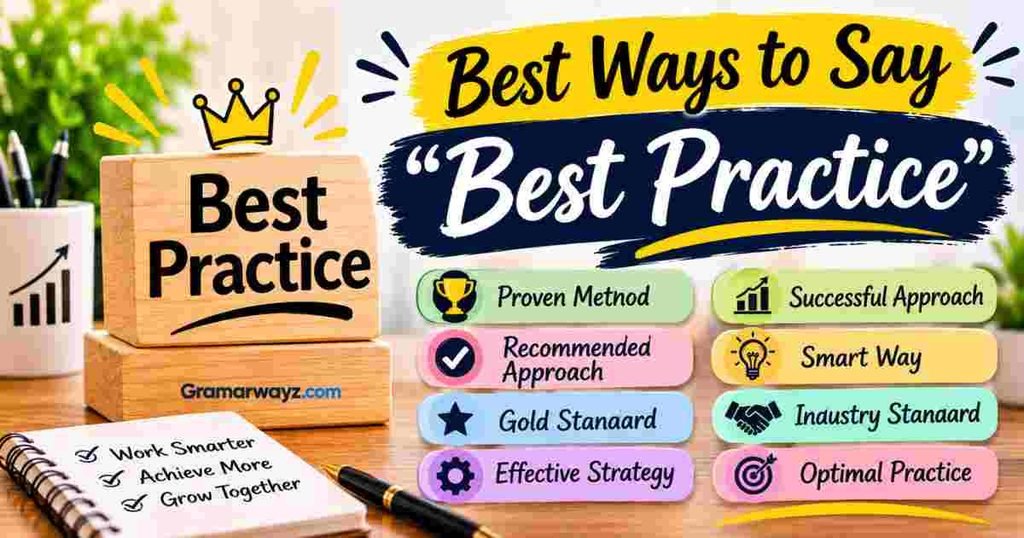

The phrase “best practice” refers to proven methods, effective approaches, and recommended ways of doing something to achieve better results. Whether you’re writing a professional email, managing a business, improving workplace productivity, or developing new skills, understanding the right best practices can help you make smarter decisions and avoid common mistakes.
However, choosing the right words also matters when you want to express this idea clearly in different situations. In this article, you’ll discover the meaning of best practice, useful examples, alternative words and phrases, and professional ways to use it in everyday communication. Keep reading to find the most suitable expressions for your needs.
What Does “Best Practice” Mean?
The phrase “best practice” refers to a recommended or proven way of doing something that helps achieve effective, reliable, and consistent results. It is commonly used in professional settings, businesses, education, healthcare, and everyday communication. A best practice is usually based on experience, research, industry standards, or methods that have worked successfully in similar situations. For example, regularly backing up important files is considered a best practice for protecting digital information.
When to Use Best Practice
You can use “best practice” when discussing recommended methods, professional standards, or effective approaches to completing a task. It works particularly well when sharing advice, explaining procedures, improving workplace performance, or guiding others toward better results.
Common situations include:
- Workplace communication: Recommending effective ways to complete tasks.
- Business management: Explaining reliable processes and strategies.
- Healthcare: Discussing safe and effective patient care methods.
- Education: Sharing successful teaching and learning techniques.
- Customer service: Describing ways to improve customer satisfaction.
- Technology: Recommending secure and efficient digital practices.
Is It Professional/Polite to Say Best Practice?
Yes, “best practice” is a professional, polite, and widely accepted expression. It is suitable for workplace emails, business reports, meetings, presentations, and formal discussions. It communicates that a particular approach is recommended because it follows established standards or has demonstrated positive results.
However, context matters. If you are making a suggestion rather than stating an established standard, phrases such as “recommended approach,” “effective method,” or “suggested procedure” may sound more collaborative and less authoritative.
Business Operations Example
In business operations, best practices help organizations improve productivity, maintain consistency, reduce errors, and manage resources effectively. They can include standard operating procedures, employee training, project planning, and regular performance reviews.
Example: “Following best practices in inventory management can help reduce waste and prevent stock shortages.”
Healthcare Example
In healthcare, best practices refer to evidence-based methods and recommended procedures that support patient safety, improve treatment quality, and reduce medical risks. Healthcare professionals use established guidelines to make informed decisions and provide consistent patient care.
Example: “Following best practices in infection prevention helps protect patients and healthcare workers.”
Education Example
In education, best practices are effective teaching methods and learning strategies that help students understand lessons, develop skills, and achieve academic goals. Teachers use these approaches to create supportive classrooms and improve student engagement.
Example: “Using interactive activities is a best practice for encouraging student participation in the classroom.”
Customer Service Example
In customer service, best practices are recommended ways to communicate with customers, resolve complaints, answer questions, and create positive experiences. These methods help businesses build trust, improve customer satisfaction, and maintain strong relationships.
Example: “Responding to customer questions promptly is a best practice for providing excellent customer service.”
The Most Useful Alternatives to “Best Practice”
The phrase “best practice” is commonly used in professional communication, business writing, workplace discussions, and everyday situations. However, repeating it too often can make your writing sound less natural. Depending on the context, you can use alternatives such as proven method, smart approach, reliable technique, effective strategy, or standard practice. Each expression has a slightly different meaning, so choosing the right one helps you communicate more clearly and professionally.
Proven Method
A proven method refers to an approach that has been tested and shown to produce successful results. It is a useful alternative to “best practice” when you want to emphasize experience, evidence, or a history of success. This phrase works well in business, education, technology, and professional discussions.
Examples:
- Following a proven method can help employees complete their tasks more efficiently.
- Our team uses a proven method to improve customer satisfaction and reduce complaints.
This expression is especially suitable when recommending something that has already worked in similar situations.
Smart Approach
A smart approach means using a thoughtful, practical, and well-planned way to handle a particular task or challenge. It is a more conversational alternative to “best practice” and works well in workplace discussions, business advice, and informal professional communication.
Examples:
- Creating a daily schedule is a smart approach to managing multiple responsibilities.
- A smart approach to marketing can help small businesses reach their target audience.
Use this phrase when emphasizing good judgment, careful planning, and sensible decision-making rather than established industry standards.
Read more: Other Ways to Say Hope All Is Well
Reliable Technique
A reliable technique describes a method or skill that consistently produces dependable results. It is an appropriate alternative when discussing processes that require accuracy, consistency, and trust. You can use it in technical writing, professional training, education, and business communication.
Examples:
- Regularly reviewing financial records is a reliable technique for identifying accounting errors.
- Breaking complicated lessons into smaller steps is a reliable technique for improving student understanding.
This phrase is particularly useful when you want to highlight consistency and dependability.
Modern Practice
A modern practice refers to a current method, procedure, or approach that reflects updated knowledge, technology, or professional standards. It is useful when discussing improvements and contemporary ways of working.
Examples:
- Remote collaboration has become a modern practice in many international organizations.
- Using digital learning platforms is a modern practice in today’s education system.
Choose this alternative when the focus is on updated procedures, current industry trends, or changes in traditional working methods.
Effective Strategy
An effective strategy means a carefully planned approach that helps achieve a specific goal or desired outcome. It is a strong alternative to “best practice” in business reports, marketing plans, workplace communication, and professional recommendations.
Examples:
- Setting measurable goals is an effective strategy for improving team performance.
- Offering personalized support is an effective strategy for building long-term customer relationships.
This expression works best when discussing planned actions, business decisions, and methods designed to deliver measurable results.
Core Procedure
A core procedure refers to an essential process or set of steps that forms an important part of completing a task correctly. It is particularly useful in formal documents, workplace instructions, technical guidelines, and organizational policies.
Examples:
- Checking equipment before operation is a core procedure in industrial workplaces.
- Verifying patient information is a core procedure in hospital administration.
Use this phrase when referring to an important operational step that employees or professionals are expected to follow consistently.
Trusted Method
A trusted method describes an approach that people consider dependable because of its successful results, reputation, or consistent performance. It is a natural alternative when recommending something that has earned confidence over time.
Examples:
- Regular communication is a trusted method for maintaining strong relationships with clients.
- Practicing previous exam questions is a trusted method for preparing for academic tests.
This expression is useful in advice, recommendations, training materials, and situations where reliability and confidence matter.
Advanced Approach
An advanced approach refers to a more developed, sophisticated, or specialized way of handling a task. It often involves improved techniques, modern tools, or deeper knowledge than traditional methods.
Examples:
- The company adopted an advanced approach to data analysis to improve its decision-making process.
- Teachers are exploring an advanced approach to personalized learning through digital technology.
Use this alternative when describing innovative solutions, specialized processes, or improvements that go beyond basic procedures.
Learn More: Other Ways to Say “Keep Up the Good Work”
Key Technique
A key technique means an important skill, method, or action that plays a significant role in achieving a successful outcome. It is useful in educational content, professional training, business discussions, and instructional writing.
Examples:
- Active listening is a key technique for resolving customer complaints effectively.
- Regular revision is a key technique for remembering important information before an examination.
This phrase is appropriate when you want to highlight one particularly important part of a larger process.
Standard Practice
A standard practice refers to an accepted or commonly followed way of doing something within a particular profession, organization, or industry. It is one of the closest alternatives to “best practice,” especially when discussing established rules and procedures.
Examples:
- Wearing protective equipment is a standard practice on construction sites.
- Conducting regular performance reviews is a standard practice in many organizations.
Use this expression when describing an established procedure that people are generally expected to follow.
Simple Method
A simple method means an easy-to-understand and straightforward way of completing a task without unnecessary steps or complications. It is a suitable alternative when the main goal is to make a process more accessible and manageable.
Examples:
- Using a shared calendar is a simple method for organizing team meetings.
- Writing short summaries is a simple method for remembering important information.
This phrase works well in beginner-friendly guides, everyday advice, tutorials, and situations where simplicity is more important than complexity.
Professional Strategy
A professional strategy refers to a planned approach used in a workplace or business environment to achieve specific objectives. It emphasizes expertise, organization, and careful decision-making.
Examples:
- Developing a professional strategy for employee training can improve workplace performance.
- A professional strategy for handling complaints helps businesses maintain customer trust.
Choose this phrase when discussing career development, business planning, management decisions, or formal workplace recommendations.
Practical Approach
A practical approach means choosing a realistic and useful way to solve a problem or complete a task. Instead of focusing only on theories, it emphasizes actions that can be applied in real-life situations.
Examples:
- Creating a monthly budget is a practical approach to managing personal expenses.
- Providing hands-on activities is a practical approach to teaching complex subjects.
This alternative is especially useful when recommending realistic solutions that people can apply immediately.
Verified Technique
A verified technique refers to a method that has been checked, tested, or supported by reliable evidence. It is useful in technical, scientific, educational, and professional contexts where accuracy and credibility are important.
Examples:
- The researchers used a verified technique to ensure accurate laboratory results.
- Following a verified technique can help technicians identify equipment problems more consistently.
Use this expression when you want to emphasize that a particular method has undergone testing or confirmation rather than simply being recommended.
Strong Method
A strong method describes a dependable and effective way of handling a task, solving a problem, or achieving a particular objective. It is a flexible expression that can fit business communication, education, personal development, and professional advice.
Examples:
- Setting clear expectations is a strong method for improving communication between managers and employees.
- Combining regular practice with feedback is a strong method for developing new skills.
This phrase works when you want to describe an approach that offers a solid foundation for achieving positive results.
Efficient Procedure
An efficient procedure refers to an organized series of steps designed to complete a task with minimal wasted time, effort, or resources. It is a useful alternative to “best practice” when discussing productivity, workplace operations, and process improvement.
Examples:
- Following an efficient procedure can help employees complete routine tasks more quickly.
- The company introduced an efficient procedure to reduce delays in order processing.
Use this phrase when emphasizing speed, organization, and better use of available resources.
Best Practice Model
A best practice model is a structured example or framework that demonstrates an effective way to perform a particular activity. It is commonly used in business management, education, healthcare, and organizational development.
Examples:
- The organization developed a best practice model for improving employee training.
- Schools can use a best practice model to create more effective learning environments.
This expression works well when describing a successful system that others can follow or adapt.
Strategic Method
A strategic method refers to a planned approach that considers long-term objectives, available resources, and possible challenges. It is a suitable alternative when discussing business planning, management, and important professional decisions.
Examples:
- Using a strategic method can help businesses expand into new markets.
- The manager introduced a strategic method for improving team productivity.
Choose this phrase when the focus is on planning, priorities, and achieving specific goals.
Explore: Best Wish You All the Best in Your Future Endeavours
Clean Workflow
A clean workflow means a clear, organized process in which tasks follow a logical sequence without unnecessary complications. It is especially useful in project management, software development, office operations, and team collaboration.
Examples:
- Creating a clean workflow helps team members understand their responsibilities.
- The development team introduced a clean workflow to reduce confusion during software testing.
Use this expression when describing a simple, organized, and easy-to-manage working process.
Expert Approach
An expert approach refers to a method based on specialized knowledge, professional experience, and subject expertise. It is useful when explaining how qualified individuals handle complex tasks or make informed decisions.
Examples:
- An expert approach to financial planning can help businesses manage their budgets more effectively.
- The hospital introduced an expert approach to improving patient care procedures.
This phrase is appropriate when emphasizing professional knowledge, experience, and informed judgment.
Structured Method
A structured method describes an organized way of completing a task through clearly defined stages, instructions, or steps. It is a helpful alternative to “best practice” in training, research, education, and business operations.
Examples:
- A structured method helps new employees understand their daily responsibilities.
- Researchers followed a structured method to collect and analyze information.
Use this phrase when consistency, organization, and clear procedures are important.
Refined Strategy
A refined strategy refers to an improved plan that has been adjusted to make it more effective, practical, or suitable for a particular situation. It is commonly used in business, marketing, leadership, and project management.
Examples:
- The company developed a refined strategy to attract more potential customers.
- After reviewing the results, the team introduced a refined strategy for managing projects.
This expression is useful when describing improvements made to an existing plan rather than starting from scratch.
Proven Workflow
A proven workflow means an established sequence of tasks that has demonstrated successful results in real working situations. It is particularly relevant to businesses, creative teams, technology companies, and project-based environments.
Examples:
- Following a proven workflow helps designers complete projects with fewer delays.
- The company adopted a proven workflow to improve communication between departments.
Choose this phrase when highlighting a process that has already been tested and shown to work reliably.
Optimal Technique
An optimal technique refers to a method considered especially suitable for achieving the best possible result under specific conditions. It is useful in technical writing, scientific research, professional training, and performance improvement.
Examples:
- Selecting the optimal technique can improve accuracy during laboratory testing.
- The coach introduced an optimal technique for helping athletes improve their performance.
Use this expression when comparing different methods and identifying the most suitable one for a particular objective.
See More: Other Ways to Say “Sorry To Hear That”
Leading Framework
A leading framework describes a recognized or influential structure that guides people in organizing tasks, making decisions, or achieving specific goals. It is often used in business management, technology, education, and professional development.
Examples:
- The organization adopted a leading framework for managing information security.
- This leading framework helps managers evaluate performance and identify areas for improvement.
This phrase works best when discussing established systems, industry guidance, or widely recognized professional models.
Improved Method
An improved method refers to an updated or modified way of doing something that offers better results than an earlier approach. It is a straightforward alternative to “best practice” when discussing progress, efficiency, and problem-solving.
Examples:
- The team introduced an improved method for tracking customer feedback.
- Teachers developed an improved method for explaining difficult mathematical concepts.
Use this phrase when describing changes that make an existing process easier, faster, or more effective.
Consistent Practice
A consistent practice refers to a regular and dependable way of performing an activity over time. It emphasizes maintaining the same quality, standards, or habits across different situations.
Examples:
- Regularly checking product quality is a consistent practice in successful manufacturing operations.
- Giving students timely feedback is a consistent practice that supports better learning.
This expression is useful when discussing routines, professional standards, quality control, and long-term improvement.
Guided Method
A guided method describes an approach in which people follow instructions, expert advice, or clearly defined steps to complete a task correctly. It is particularly useful in education, employee training, and professional development.
Examples:
- A guided method helps beginners understand how to use unfamiliar software.
- The training program uses a guided method to teach employees new safety procedures.
Choose this phrase when explaining processes that require direction, supervision, or step-by-step support.
Accurate Approach
An accurate approach refers to a method that emphasizes correctness, precision, and attention to important details. It is especially relevant to research, accounting, healthcare, technical work, and data management.
Examples:
- Using an accurate approach to record financial information helps prevent reporting errors.
- The research team adopted an accurate approach to measuring experimental results.
Use this alternative when the main priority is producing correct and dependable information.
Stable Strategy
A stable strategy means a dependable plan designed to maintain consistent progress and reduce unnecessary changes or risks. It is commonly used in business planning, financial management, leadership, and long-term project development.
Examples:
- Developing a stable strategy can help businesses manage unexpected market changes.
- The management team created a stable strategy for maintaining long-term operational growth.
This phrase is suitable when discussing reliability, continuity, and plans that can support an organization over time.
Scalable Method
A scalable method refers to an approach that can grow or adapt as requirements, workloads, or business operations increase. It is a useful alternative to “best practice” when discussing long-term planning, technology, business development, and organizational growth.
Examples:
- Using a scalable method allows the company to manage more customers without increasing operational complexity.
- The development team adopted a scalable method to support future software updates.
Use this phrase when describing processes that can handle growth while maintaining efficiency and quality.
See Also: “Looking Forward to Working” With You Fresh Guide
Modern Workflow
A modern workflow describes an updated and organized way of completing tasks using current tools, technologies, and working methods. It is commonly used in digital businesses, project management, remote work, and professional environments.
Examples:
- A modern workflow helps employees collaborate more effectively across different departments.
- The company introduced a modern workflow to automate repetitive administrative tasks.
Choose this expression when discussing updated processes, digital transformation, and improved workplace organization.
Reliable Practice
A reliable practice refers to a dependable way of performing an activity that produces consistent and satisfactory results. It is suitable for professional communication, business operations, education, and quality management.
Examples:
- Reviewing important documents before submission is a reliable practice for reducing mistakes.
- Regular equipment maintenance is a reliable practice in manufacturing facilities.
This phrase works well when emphasizing consistency, dependability, and responsible working habits.
Trusted Strategy
A trusted strategy describes a plan that people rely on because it has demonstrated value, produced positive results, or earned professional confidence. It is useful in business planning, marketing, management, and customer relationships.
Examples:
- Building strong customer relationships is a trusted strategy for encouraging repeat business.
- The company followed a trusted strategy to maintain its position in a competitive market.
Use this alternative when recommending an approach that has earned confidence through experience or successful outcomes.
Performance Method
A performance method refers to a particular way of measuring, managing, or improving how well a person, team, or system works. It is commonly used in employee development, sports, business management, and organizational improvement.
Examples:
- The manager introduced a performance method to evaluate employee productivity.
- Using regular feedback is a performance method that helps teams identify areas for improvement.
This expression is useful when discussing productivity, measurable results, and performance evaluation.
Recommended Approach
A recommended approach means a suggested way of handling a task or situation based on professional knowledge, experience, or available evidence. It is one of the most natural alternatives to “best practice” in workplace communication and formal writing.
Examples:
- The recommended approach is to review the project requirements before assigning responsibilities.
- Using strong passwords is a recommended approach to improving online account security.
Choose this phrase when offering guidance, sharing professional advice, or suggesting a suitable course of action without sounding overly forceful.
Effective Procedure
An effective procedure refers to a clear set of steps that helps achieve a specific objective successfully. It is particularly useful in business operations, healthcare, administration, manufacturing, and workplace training.
Examples:
- The organization introduced an effective procedure for handling customer complaints.
- Following an effective procedure helps laboratory workers maintain accurate records.
Use this expression when discussing processes that produce the desired results while maintaining consistency and control.
Established Method
An established method describes a recognized way of doing something that has been used and accepted over time. It is suitable for formal documents, academic writing, technical discussions, and professional communication.
Examples:
- The research team used an established method to analyze the collected data.
- Regular inspections are an established method of maintaining equipment safety.
This phrase is particularly useful when referring to familiar procedures, accepted standards, or methods with a history of practical use.
Successful Strategy
A successful strategy refers to a plan or approach that has achieved its intended goals or delivered positive outcomes. It is commonly used in marketing, business development, leadership, education, and project management.
Examples:
- Improving product quality proved to be a successful strategy for increasing customer loyalty.
- The school introduced a successful strategy to encourage greater student participation.
Use this expression when highlighting an approach that has produced measurable improvements or achieved a particular objective.
Ideal Practice
An ideal practice means a particularly suitable or desirable way of performing an activity under specific circumstances. It is useful when discussing preferred procedures, professional recommendations, organizational standards, and quality improvement.
Examples:
- Keeping accurate financial records is an ideal practice for responsible business management.
- Providing clear instructions is an ideal practice when introducing new employees to workplace procedures.
Choose this phrase when describing a preferred way of working that supports quality, accuracy, and positive results.
Tested Approach
A tested approach refers to a method or way of doing something that has been tried and evaluated to determine whether it works effectively. It is a useful alternative to “best practice” when discussing reliable solutions, professional recommendations, and problem-solving techniques.
Examples:
- The company adopted a tested approach to improve its employee training program.
- Using regular feedback is a tested approach to improving team communication.
Use this phrase when emphasizing that an idea or method has been tried before and offers practical value.
Quality Standard
A quality standard refers to an established level of performance, service, or production that an organization or professional is expected to maintain. It is commonly used in manufacturing, healthcare, business operations, and customer service.
Examples:
- Every product must meet the company’s quality standard before being shipped.
- Maintaining a high quality standard helps healthcare facilities provide dependable patient care.
Choose this expression when discussing expectations, performance requirements, and maintaining consistent results.
Preferred Method
A preferred method means the approach that someone considers more suitable or effective than other available options. It is a natural alternative to “best practice” when recommending a particular way of completing a task.
Examples:
- Email is the preferred method for sharing formal project updates.
- The organization uses digital payments as its preferred method for processing customer transactions.
This phrase works well when explaining personal choices, organizational preferences, or recommended procedures.
Strategic Approach
A strategic approach refers to a carefully planned way of handling a situation while considering long-term goals, available resources, and possible challenges. It is particularly useful in business communication, leadership, marketing, and project management.
Examples:
- A strategic approach to employee development can improve long-term workplace performance.
- The company adopted a strategic approach to expanding its services into new markets.
Use this expression when discussing thoughtful planning, business objectives, and decisions designed to achieve specific outcomes.
Professional Practice
A professional practice describes an accepted or recommended way of performing tasks within a particular profession. It often reflects professional knowledge, ethical responsibilities, workplace expectations, and industry guidelines.
Examples:
- Maintaining client confidentiality is an important professional practice for legal advisors.
- Regular training is a valuable professional practice for keeping employees updated.
This phrase is suitable for formal writing, workplace policies, professional development, and discussions about industry responsibilities.
Optimized Workflow
An optimized workflow refers to an improved sequence of tasks designed to increase efficiency, reduce unnecessary steps, and make better use of available resources. It is commonly used in technology, business operations, project management, and administration.
Examples:
- The company introduced an optimized workflow to reduce delays in order processing.
- An optimized workflow helps the design team complete projects with fewer revisions.
Choose this alternative when describing processes that have been adjusted to achieve better productivity and smoother operations.
Practical Strategy
A practical strategy means a realistic and actionable plan that can be applied to solve a problem or achieve a particular goal. Unlike a purely theoretical idea, it focuses on steps that people can implement in real situations.
Examples:
- Creating a weekly budget is a practical strategy for managing household expenses.
- The manager developed a practical strategy to improve communication between departments.
Use this phrase when recommending realistic solutions, useful plans, or actions that are achievable with available resources.
Industry Standard
An industry standard refers to a recognized requirement, guideline, or level of quality commonly followed within a particular business sector or profession. It is especially useful in technical writing, business reports, manufacturing, and professional communication.
Examples:
- The company follows industry standards to maintain product safety and reliability.
- Data encryption is an important security measure used across the technology industry.
This expression works best when discussing established expectations, regulations, technical requirements, or widely recognized professional guidelines.
Efficient Method
An efficient method describes a way of completing a task while minimizing wasted time, effort, money, or resources. It is a straightforward alternative to “best practice” in business, education, workplace management, and everyday problem-solving.
Examples:
- Using automated tools is an efficient method for organizing large amounts of information.
- Preparing weekly lesson plans is an efficient method for managing classroom activities.
Use this phrase when emphasizing productivity, time management, and achieving good results with fewer unnecessary steps.
Accepted Practice
An accepted practice refers to a method or procedure that is generally recognized and followed within a particular organization, profession, or industry. It is often used in formal discussions about workplace procedures, professional expectations, and established guidelines.
Examples:
- Documenting important decisions is an accepted practice in project management.
- Wearing appropriate protective equipment is an accepted practice in many industrial workplaces.
Choose this expression when describing a commonly recognized way of doing something that aligns with established professional expectations.
Pros and Cons of Using “Best Practice”
The phrase “best practice” is widely used in professional communication, business writing, education, and workplace discussions. It helps explain recommended methods and established procedures. However, like any commonly used expression, it has advantages and a few limitations depending on the context.
| Pros | Cons |
| Sounds professional and appropriate in formal communication. | Can become repetitive when used too frequently. |
| Clearly communicates recommended methods. | May sound vague without explaining the actual procedure. |
| Works across different industries and professions. | Not every recommended method suits every situation. |
| Helps establish consistent workplace standards. | Can sound overly authoritative in casual conversations. |
| Makes business reports and guidelines easier to understand. | Sometimes suggests that only one approach is correct. |
| Supports discussions about quality and efficiency. | May become outdated when industry standards change. |
Overall: “Best practice” is a useful professional expression, but choosing alternatives such as “recommended approach,” “proven method,” or “effective strategy” can make your writing more natural, specific, and engaging.
Frequently Asked Questions
1. What does “best practice” mean?
“Best practice” means a recommended or proven way of performing a task to achieve effective and reliable results. It is commonly used in business, education, healthcare, technology, and professional environments.
2. What is another word for “best practice”?
Some useful alternatives include proven method, effective strategy, recommended approach, standard practice, reliable technique, and preferred method. The right choice depends on the context and intended meaning.
3. Is “best practice” formal or informal?
“Best practice” is generally considered a formal and professional expression. It is suitable for workplace emails, business reports, presentations, academic discussions, and organizational guidelines.
4. Can I use “recommended approach” instead of “best practice”?
Yes. “Recommended approach” is a natural alternative when suggesting a suitable way to complete a task. It sounds professional and slightly less authoritative than “best practice.”
5. What is the difference between best practice and standard practice?
Best practice refers to a recommended approach considered particularly effective, while standard practice describes a commonly accepted or regularly followed procedure. A standard practice is not necessarily the most effective option.
6. Is “proven method” the same as “best practice”?
They have similar meanings, but there is a slight difference. A proven method emphasizes that an approach has been tested and shown to work, whereas best practice highlights a recommended way of achieving good results.
7. How do you use “best practice” in a sentence?
You can use it to describe an effective or recommended procedure.
For example: “Regularly updating company software is a best practice for maintaining digital security.”
8. What is a more professional way to say “best practice”?
You can use expressions such as industry standard, established method, professional practice, recommended procedure, or effective strategy. These alternatives help make professional communication more precise.
9. Should I use “best practice” in business emails?
Yes. It is appropriate for business emails when discussing workplace standards, recommended procedures, or ways to improve performance. However, alternatives such as “suggested approach” may sound more collaborative when making recommendations.
10. Is “best practices” plural or singular?
“Best practice” is singular, while “best practices” is plural. Use “best practice” when referring to one recommended method and “best practices” when discussing multiple methods or guidelines.
Conclusion
Choosing the right alternative to “best practice” can make your writing clearer, more professional, and easier to understand. Whether you prefer expressions like proven method, recommended approach, effective strategy, industry standard, or reliable technique, each option serves a slightly different purpose.
Consider your audience, context, and intended meaning before selecting a phrase. With these alternatives, examples, and explanations, you can communicate recommendations more naturally in business emails, workplace discussions, reports, and everyday professional conversations.

I am the admin of Gramarwayz.com. I create and curate helpful synonyms, alternative words, and other ways to say common words and phrases to help readers improve their vocabulary and writing skills.