
Finding another word for throughout can help you make your writing clearer, more natural, and less repetitive. Whether you’re writing an essay, email, article, or everyday message, choosing the right synonym depends on the context and meaning you want to express.
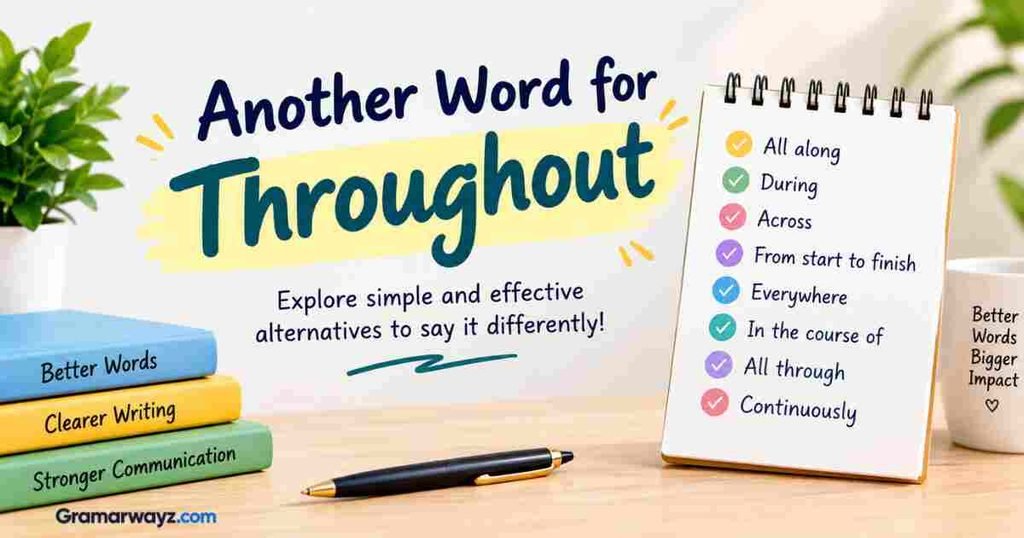
Common alternatives include during, all through, across, from beginning to end, and through the entire period. Some words describe something happening over time, while others refer to every part of a place, object, or subject. Understanding these differences will help you choose the most accurate synonym for throughout in any sentence.
In this article, you’ll discover useful words similar to throughout, alternative phrases, and practical examples to improve your vocabulary and communicate with confidence.
Throughout at a Glance
Meaning: Throughout means in every part of something or during an entire period of time.
Pronunciation: thoo-OUT
Part of Speech: Preposition and adverb.
Tone: Neutral and suitable for formal, academic, and everyday writing.
Common Uses: Describing something that continues over time or exists in every part of a place, document, or situation.
Example: The museum displayed beautiful artwork throughout the building.
Common Synonyms: During, all through, across, everywhere in, and from beginning to end. The best alternative depends on whether throughout refers to time or place.
The Most Useful Alternatives to Throughout
Choosing another word for throughout depends on whether you are describing a period of time, an entire duration, or every part of a place. Common synonyms for throughout include during, all through, over, everywhere in, across, from beginning to end, all along, and through the entirety. Understanding these similar words and alternative phrases helps you select the right expression for essays, articles, emails, and everyday writing.
1. During
During is a common synonym for throughout when referring to a specific period, event, or activity. It works well in formal writing, academic texts, and everyday conversations, although it does not always mean that something continued for the entire period.
Examples:
- The students remained focused during the examination.
- She received several phone calls during her vacation.
Use when explaining when something happened without necessarily suggesting that it lasted the whole time. Unlike throughout, it can describe an event that occurs at only one point within a longer period.
2. All Through
All through emphasizes that something continues for the entire duration of a period or extends across all parts of a place. This alternative to throughout is especially useful in conversational English and descriptive writing.
Examples:
- The baby slept peacefully all through the night.
- Colorful decorations were displayed all through the school.
Choose all through when emphasizing a complete time period or the widespread presence of something in a location. It conveys a sense of continuity and completeness.
3. Over
Over can replace throughout when discussing an extended period of time, particularly when describing changes, progress, activities, or developments. It often refers to events occurring across a span of time rather than continuously at every moment.
Examples:
- The company introduced several improvements over the past year.
- Their friendship grew stronger over many years.
Use over when describing gradual changes, long-term developments, or experiences across a period. This synonym is common in professional writing, reports, and everyday communication.
4. Everywhere In
Everywhere in is a useful alternative phrase for throughout when emphasizing that something exists or can be found in all parts of a particular place. It is more conversational than throughout and clearly communicates widespread presence.
Examples:
- Fresh flowers filled every room, and their fragrance could be noticed everywhere in the house.
- Small shops selling handmade crafts could be found everywhere in the village.
Choose everywhere when describing buildings, neighborhoods, towns, or other locations where something is widely present. Unlike some synonyms for throughout, this phrase is primarily used for places rather than time periods.
Read more: Another Word for Helpful (Best Synonyms and Examples)
5. Across
Across can serve as another word for throughout when describing something spread over a region, surface, organization, or group of locations. It emphasizes distribution across different places rather than necessarily indicating every individual part.
Examples:
- The charity organized food drives across the country.
- News of the discovery spread across the university campus.
Use across when discussing geographic areas, communities, organizations, or widespread activities. It is especially useful in news articles, business writing, and informational content that describes events in multiple locations.
6. From Beginning to End
From beginning to end means for the entire duration of an event, activity, story, or process. This phrase similar throughout emphasizes that something covers the complete period or every stage of an experience.
Examples:
- The audience remained engaged from beginning to end of the performance.
- He carefully reviewed the report from beginning to end.
Choose this expression when describing books, performances, presentations, projects, or processes with a clear starting and ending point. It is particularly effective when emphasizing completeness and uninterrupted attention.
7. All Along
All along means during the entire time or from the beginning of a situation. It can function as a related expression throughout when emphasizing that a belief, fact, or condition remained true over time.
Examples:
- She had trusted her instincts all along.
- The team knew all along that the project would require extra time.
Use all along when discussing continuing beliefs, knowledge, feelings, or situations that remain true over time. In some contexts, it specifically suggests that someone knew or understood something from the start.
8. Throughout the Entirety
Throughout the entirety emphasizes the complete duration of an event or the whole extent of something. This formal expression is related throughout the entire period and can be used in academic writing, research reports, and professional documents.
Examples:
- The researcher maintained detailed records throughout the entirety of the experiment.
- The building remained accessible throughout the entirety of the renovation.
Choose this phrase when emphasizing the full duration of a formal process, experiment, project, or event. However, throughout the entire process or simply throughout often sounds more natural in everyday English.
9. Across the Whole
Across the whole can be used to describe something that extends over an entire area, group, or system. This phrase is useful when discussing the overall extent of something, although the more natural expression often depends on the sentence.
Examples:
- The new policy was implemented across the whole organization.
- Wildflowers grew across the whole field.
Use across the whole when emphasizing the full scope of an area or organization. In some sentences, throughout the entire area or across the entire organization may sound more natural.
10. In Every Part
In every part is an alternative to throughout when referring to all sections or areas of a place, object, or subject. It emphasizes that something is present or relevant in each individual part rather than just in one location.
Examples:
- The artist added intricate details in every part of the painting.
- Natural light entered every part of the building.
Choose in every part when describing objects, buildings, documents, or spaces where something appears in all sections. It is particularly helpful when you want to emphasize completeness and attention to detail.
11. For the Duration
For the duration means during the entire period that an event, activity, or situation lasts. This expression is common in formal announcements, instructions, professional communication, and official writing.
Examples:
- Passengers must keep their seat belts fastened for the duration of the flight.
- All participants remained silent for the duration of the ceremony.
Use for the duration when emphasizing that an action or condition continues throughout a specific event or time period. It is especially useful when the beginning and end of that period are clearly understood.
See Also: Another Word for Need: 12+ Synonyms and Alternatives
12. Over the Course Of
Over the course of is a useful alternative phrase for throughout when describing something that develops, changes, or happens during a particular period. It often highlights progress, gradual change, or a sequence of events rather than uninterrupted activity.
Examples:
- Her writing skills improved over the course of the semester.
- The research team collected valuable information over the course of the study.
Choose over the course of when discussing research, education, projects, experiences, or long-term developments. This phrase works well in academic writing and professional reports.
13. From Start to Finish
From start to finish means for the entire duration of an activity or event, including its beginning and ending stages. It is a natural synonym for throughout when emphasizing that something covers the complete process.
Examples:
- The chef supervised the preparation of the meal from start to finish.
- We enjoyed the exciting documentary from start to finish.
Use from start to finish when describing tasks, projects, performances, journeys, or activities that involve a complete sequence. It emphasizes continuity and completeness in both conversational and written English.
14. End to End
End to end describes something that extends from one end to the other. It is often used to explain the full length of a physical space, system, process, or service. Unlike throughout, it does not always mean that something exists in every part or continues for an entire period.
Examples:
- The workers inspected the pipeline from end to end.
- The new software manages the end-to-end process of handling customer orders.
Choose end to end when referring to complete physical coverage, connected systems, or an entire process. In business and technology writing, end-to-end is commonly hyphenated when used as an adjective, as in end-to-end service.
More Words and Phrases for Throughout
If you need another word for throughout, several alternatives can help you express the same idea with greater accuracy. The right choice depends on whether you mean an entire period of time, every part of a place, or the complete extent of an activity. Options such as for the whole time, in every section, across the region, during the entire process, and from start to finish can make your writing more precise.
Here are additional phrases you can use according to the meaning you want to convey:
- For the whole time: Emphasizes that something continues for an entire period.
- In every section: Highlights the presence of something in all parts of a document, object, or structure.
- Across the region: Describes something distributed across a geographic area.
- During the entire process: Refers to an activity that continues through every stage of a process.
- From one end to the other: Emphasizes the full length or extent of something.
- At every stage: Focuses on each step or phase of an activity.
- Throughout the period: Refers to the complete span of a specified time.
- In all areas: Highlights the presence or application of something across multiple locations or sections.
These synonyms and alternative phrases for throughout are not always interchangeable. For example, at every stage emphasizes separate steps, while for the whole time emphasizes duration. Selecting an expression that matches your intended meaning helps your sentences sound natural and clear.
Alternatives to Throughout by Meaning
The best synonym for throughout depends on the context of your sentence. Some alternatives describe continuous time, while others emphasize location, coverage, or the stages of a process. Understanding these differences will help you choose the right phrase for essays, reports, presentations, and everyday communication.
For an Entire Period of Time
When throughout refers to a complete time period, alternatives such as for the entire duration, all the while, during the whole period, and for the whole time can communicate a similar meaning. However, the exact choice depends on whether you want to emphasize continuous activity or simply identify when something happened.
Examples:
- The security team remained on duty for the entire duration of the event.
- She continued practicing all the while the competition was underway.
The first sentence emphasizes that the security team stayed on duty for the complete event. The second highlights an activity that continued during the relevant period.
Use for the entire duration when you want to stress completeness. Choose during when you only need to identify a time frame, because an event occurring during a period does not necessarily last for that whole period.
For a Large Area or Many Places
When throughout describes a place, it often means that something is present or distributed across a wide area. Suitable alternatives include across the region, in every corner, all over, and through every part. Each phrase offers a slightly different emphasis.
Examples:
- The conservation project supported wildlife protection across the region.
- Detailed safety instructions were displayed in every corner of the facility.
In the first sentence, across the region emphasizes geographic reach. In the second, in every corner draws attention to the presence of instructions in all parts of a particular facility.
Use all over for a more conversational tone, especially when describing widespread distribution. For formal reports, across the region or throughout the facility may fit better.
For a Process or Project
When describing a project or process, throughout can refer to something that continues across multiple stages or remains relevant from start to completion. Alternatives include at every stage, from start to finish, during the entire process, and through each phase.
Examples:
- The quality assurance team checked the equipment at every stage of production.
- Clear communication remained essential from start to finish of the project.
The first example emphasizes checks performed at individual stages. The second highlights the importance of communication across the whole project.
Choose at every stage when focusing on separate steps or checkpoints. Use from start to finish when emphasizing the complete process rather than its individual parts. This distinction is particularly useful in project management, business writing, and technical documentation.
For a Book, Report, or Presentation
When discussing written or spoken material, throughout can describe a theme, detail, or idea that appears across the complete work. Alternatives include in every chapter, across the report, from beginning to end, and through the entire presentation.
Examples:
- The author explores the theme of personal responsibility in every chapter.
- The speaker used clear examples through the entire presentation.
The first sentence emphasizes the repeated appearance of a theme in individual chapters. The second suggests that clear examples were used across the presentation.
Use in every chapter when referring to the structure of a book, across the report when discussing a document’s overall coverage, and from beginning to end when emphasizing the complete reading or presentation experience.
How Different Alternatives Change a Sentence
Although several expressions can replace throughout, they do not always communicate exactly the same meaning. Some emphasize duration, others highlight location, and a few focus on individual stages. Understanding these distinctions helps you avoid awkward or inaccurate word choices.
Consider how these alternatives change the emphasis of a sentence:
| Original sentence | Alternative sentence | Difference in meaning |
| The lights stayed on throughout the night. | The lights stayed on all night long. | Both emphasize the entire night; the alternative sounds more conversational. |
| The campaign expanded throughout the country. | The campaign expanded across the country. | Both describe broad geographic reach, but across highlights distribution among locations. |
| She remained confident throughout the interview. | She remained confident from start to finish of the interview. | The second expression explicitly emphasizes the interview’s beginning and ending. |
| The team reviewed the documents throughout the project. | The team reviewed the documents at every stage of the project. | The alternative emphasizes repeated reviews at individual stages rather than continuous activity. |
When choosing a replacement for throughout, consider three important factors:
- Meaning: Does the sentence refer to time, place, or a complete process?
- Tone: Would a conversational phrase or a more formal expression fit better?
- Grammar: Does the alternative work naturally with the words that follow it?
For instance, during the meeting is grammatically natural, but during every corner of the building is not. A location-based phrase such as in every part of the building would be more appropriate.
The goal is not simply to replace one word with another. It is to preserve the intended meaning while making the sentence clearer, more precise, and easier to read.
Natural Word Pairings With Throughout
The word throughout commonly appears with nouns that describe time periods, locations, documents, processes, and experiences. Learning these natural word pairings, also called collocations, can help you use the word correctly in professional writing, academic assignments, and everyday English.
Here are some common combinations and how they are used.
| Word pairing | Meaning | Example sentence |
| Throughout the day | During the entire day or at different times during the day | Customer requests arrived throughout the day. |
| Throughout the year | During the year as a whole | The garden attracts different birds throughout the year. |
| Throughout history | Across different periods of recorded or known history | Trade has influenced cultural exchange throughout history. |
| Throughout the world | In many or all parts of the world | The tradition is recognized throughout the world. |
| Throughout the country | Across a country or in many parts of it | New training centers opened throughout the country. |
| Throughout the process | During the entire process or at various points within it | The engineer monitored the equipment throughout the process. |
| Throughout the report | In different sections or across the complete report | The researcher used consistent terminology throughout the report. |
| Throughout the meeting | During the meeting, often emphasizing continued activity | The manager encouraged questions throughout the meeting. |
How to Use Throughout Naturally
Throughout can function as a preposition when followed by a noun phrase, as in throughout the semester or throughout the building. It can also function as an adverb, meaning everywhere or in every part, as in The design is consistent throughout.
Keep these usage tips in mind:
- Use throughout the day when describing something occurring across the day’s duration.
- Use throughout the building when referring to multiple areas within a structure.
- Use throughout the report when an idea, style, or detail appears across the document.
- Use throughout the process when emphasizing that something remains relevant across the stages of an activity.
Remember that throughout does not always mean uninterrupted activity. For example, the sentence “Emails arrived throughout the afternoon” means that messages arrived at different times during that period, not necessarily every minute.
Understanding these natural word combinations, synonyms, and context-dependent alternatives can help you choose the most appropriate expression for your sentence. By considering the meaning and context, you can use another word for throughout accurately in everyday conversations and written content.
Throughout vs. During: What Is the Difference?
Throughout and during both refer to time, but they do not always express the same meaning. Throughout often emphasizes the whole duration of an event, while during identifies a time period in which something happens. Understanding this difference helps you choose the right word for essays, emails, reports, and everyday conversations.
Examples:
- The students remained attentive throughout the lecture.
- Several students asked questions during the lecture.
In the first sentence, throughout emphasizes that the students remained attentive for the entire lecture. In the second, during tells us when the questions were asked without suggesting that questions occurred continuously.
Use throughout when you want to emphasize the entire duration or extent of something. Choose when the main purpose is to identify when an event occurred. In some sentences, both words are grammatically correct, but the emphasis changes.
Throughout vs. Across for Places
Throughout and across can both describe something spread over a geographical area or physical space. However, throughout often emphasizes presence in many or all parts of an area, whereas across tends to highlight distribution, reach, or movement from one area to another.
Examples:
- Security cameras were installed throughout the building.
- The company opened new offices across the country.
In the first example, throughout suggests that cameras were installed in many parts of the building. In the second, across emphasizes that the company’s offices are distributed among different locations nationwide.
Use throughout when highlighting widespread presence within an area. Choose across when emphasizing geographic reach, distribution, or movement. The two expressions can overlap, so the most natural choice depends on the sentence.
Formal and Casual Alternatives
The best alternative throughout also depends on the tone of your writing. Some expressions suit academic papers and professional reports, while others sound more natural in conversations, text messages, and informal descriptions.
| Formal alternative | Casual alternative | Example |
| For the entire duration | All the way through | She remained involved for the entire duration of the project. |
| Throughout the period | All through | It rained all through the night. |
| Across the entire region | All over | The festival became popular all over the town. |
| Over the course of | Over | The team improved over several months. |
| At every stage | From start to finish | He supported the team from start to finish. |
For formal writing, expressions such as for the entire duration, throughout the period, and over the course of can communicate precise relationships between events and time periods.
For casual writing, all through, all over, and from start to finish often sound more conversational. However, some casual expressions are also perfectly appropriate in professional contexts when they fit the sentence.
Always consider your audience, the purpose of the text, and the specific meaning you want to communicate before selecting a replacement.
Similar Words That Do Not Always Mean the Same Thing
Many synonyms for throughout share a similar meaning but cannot be substituted in every sentence. Some describe a complete time period, while others indicate a particular moment, broad coverage, or separate stages. Recognizing these differences helps prevent grammatical mistakes and unclear writing.
Here are some important distinctions:
– During vs. Throughout: During identifies a period in which something happens, while throughout often emphasizes the entire period. For example, She spoke during the meeting does not mean she spoke continuously throughout it.
– Across vs. Throughout: Across often highlights distribution or movement between locations, while throughout emphasizes presence across an area. For example, They traveled across the country suggests movement, whereas They have offices throughout the country suggests widespread presence.
– Over vs. Throughout: Over often describes change or development across a period, while throughout can emphasize something happening or remaining true across that period. For example, Sales increased over the year describes change, while Demand remained strong throughout the year emphasizes continued strength.
– All along vs. Throughout: All along often means that something was true from the beginning or that someone knew something from the start. Throughout is more neutral and can describe duration or extent. For example, She knew the answer all along suggests she knew it from the beginning.
– Everywhere in vs. Throughout: Both can describe widespread presence, but everywhere in is more conversational. For example, Plants grew throughout the garden and Plants grew everywhere in the garden convey similar ideas, though the second sounds more informal.
When selecting a word similar to throughout, check whether it preserves the original sentence’s meaning, grammar, and tone. A synonym is useful only when it fits the context naturally.
Natural Examples Using Alternatives to Throughout
Seeing throughout synonyms in complete sentences makes it easier to understand their meaning and use them correctly. The following examples demonstrate how different alternatives work in everyday, academic, and professional writing.
- During: The manager answered several questions during the presentation.
- All through: The children laughed all through the journey.
- Over: The business expanded steadily over five years.
- Everywhere in: Bright artwork could be seen everywhere in the community center.
- Across: The organization provides educational resources across the region.
- From beginning to end: The documentary kept viewers interested from beginning to end.
- All along: He had suspected the truth all along.
- For the duration: Visitors were asked to remain seated for the duration of the performance.
- At every stage: The supervisor checked the work at every stage of production.
- From start to finish: She managed the event from start to finish.
Each expression serves a slightly different purpose. During identifies a time frame, across highlights geographic reach, and at every stage emphasizes separate steps. Meanwhile, from start to finish and for the duration stress completeness.
To choose the right alternative, identify whether your sentence focuses on time, place, continuity, or a complete process. This simple distinction will help you write more naturally without repeating the same word.
Opposite Words and Ideas for Throughout
The word throughout does not have one universal antonym because its meaning changes with context. When it refers to an entire period or all parts of a place, its opposite may express a limited duration, partial coverage, or restricted extent.
Here are some context-dependent opposites and contrasting expressions:
- Partly: Refers to only some of something rather than the whole. Example: The building was partly renovated, not throughout.
- Occasionally: Describes something that happens from time to time rather than continuing or recurring across an entire period. Example: She occasionally checked her email during the afternoon.
- In some places: Refers to selected locations rather than widespread presence. Example: The new signs appeared in some places, not throughout the town.
- At the beginning: Refers to the starting point of a period or event rather than its entire duration. Example: He explained the rules at the beginning of the meeting.
- In one section: Limits something to a specific part of a larger object or document. Example: The additional information appeared in one section of the report.
These expressions are not direct antonyms in every situation. For example, occasionally contrasts with the idea of continuous activity, while in some places contrasts with widespread geographic coverage.
When looking for an opposite of throughout, first determine whether the original word refers to time or place. Then choose an expression that accurately communicates the intended limitation, interruption, or partial extent.
FAQs About Another Word for Throughout
1. What is another word for throughout?
Another word for throughout is during, across, all through, or over, depending on the context. These alternatives can describe an entire time period or different parts of a place.
2. What is the best synonym for throughout?
The best synonym for throughout depends on your sentence. During works well for time periods, while across is useful for locations and from start to finish emphasizes the entire duration of an activity.
3. What is another word for throughout a period of time?
Common alternatives include during, all through, over the course of, and for the duration of. Choose the phrase that best expresses whether something happens within a period or continues from beginning to end.
4. What is another word for throughout a place?
Words and phrases such as across, everywhere in, in every part of, and throughout the whole area can describe something spread across a location.
5. Is throughout the same as during?
No, throughout and during have slightly different meanings. Throughout often emphasizes something happening across an entire period, while during simply indicates that it happens within a particular time.
6. How can I use another word for throughout in a sentence?
Choose a synonym that fits your intended meaning. For example, “She remained focused throughout the meeting” can become “She remained focused during the meeting.” Use all through or from start to finish when you want to emphasize the full duration.
Conclusion
Choosing another word for throughout depends on the meaning you want to express and the context of your sentence. Words such as during, across, over, and from start to finish offer useful alternatives, but each has a slightly different purpose.
Use during when referring to a time period, across when describing different places or areas, and all through when emphasizing something that continues for an entire period. For professional writing, consider the sentence’s tone, meaning, and grammatical structure before replacing the original word.
The best synonym is one that sounds natural and keeps your message clear. Apply these alternatives in your everyday writing to make your sentences more precise and effective.

I am the admin of Gramarwayz.com. I create and curate helpful synonyms, alternative words, and other ways to say common words and phrases to help readers improve their vocabulary and writing skills.