
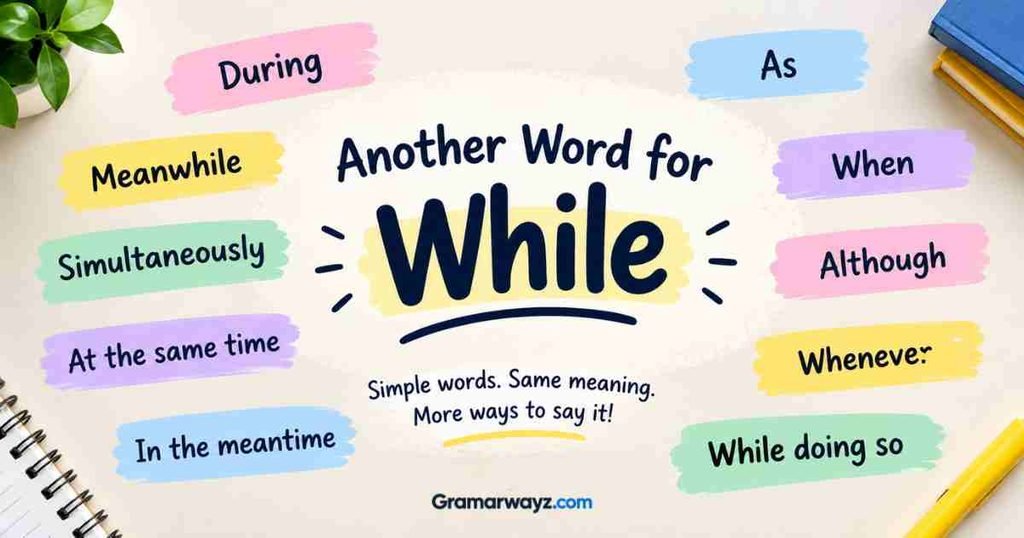

Finding the right words can make your writing sound clearer, smoother, and more professional. If you often use “while” in essays, emails, conversations, or everyday sentences, exploring another word for while can help you express your ideas more naturally.
Common synonyms for while include during, as, when, although, whereas, whilst, and meanwhile. These alternatives can express simultaneous actions, a period of time, duration, or contrast, depending on the sentence context.
However, not all words similar to while are interchangeable, as each has a slightly different meaning and grammatical usage. Understanding time conjunctions, subordinating conjunctions, and connecting words can help you choose the correct replacement.
Whether you need formal alternatives for professional writing or natural expressions for everyday conversations, this guide explores useful alternatives to while, their meanings, grammar rules, and practical examples to help you improve your English vocabulary and sentence structure.
While at a Glance
- Meaning: “While” refers to a period of time or introduces a contrast between two ideas.
- Pronunciation: /waɪl/ (rhymes with “mile”).
- Part of Speech: Conjunction and noun.
- Tone: Neutral; suitable for formal and informal writing.
- Common Uses: Describing simultaneous actions, indicating duration, and expressing contrast.
- Common Synonyms: During, as, when, whilst, although, and whereas, depending on the context.
- Example: “While I was studying, my sister was preparing dinner.”
Choosing another word for while depends on the sentence’s meaning. For example, during emphasizes a period of time, while whereas highlights a contrast between two ideas.
The Most Useful Alternatives to While
Choosing another word for while depends on how it functions in a sentence. It can describe two actions happening at the same time, refer to a period of time, or introduce a contrast between ideas. Words and phrases such as during, as, whilst, when, and meanwhile can replace “while” in certain contexts, but they are not always interchangeable. Understanding their meanings and grammatical uses will help you write more clearly in essays, emails, professional communication, and everyday conversations.
1. During
During is a useful alternative to “while” when referring to something that happens within a particular period or event. Unlike “while,” which is commonly followed by a subject and verb, during is generally followed by a noun or noun phrase. It works well when you want to emphasize when an action takes place.
Examples:
- The students remained quiet during the examination.
- I received an important phone call during my lunch break.
In the first example, “during the examination” identifies the period when the students remained quiet. In the second, “during my lunch break” explains when the phone call occurred. Use “during” when the focus is on a specific event or time period rather than on two ongoing actions.
2. As
As can replace “while” when describing two actions happening simultaneously. It can also show how one event occurs alongside another or how a situation changes over time. This word is particularly useful in storytelling, descriptive writing, and everyday communication.
Examples:
- As I walked through the park, I listened to my favorite music.
- The sky grew darker as the storm approached.
In the first example, “as” connects walking and listening, showing that both actions happen together. In the second, it links two developments occurring at the same time. Choose “as” when you want to connect related actions or describe changes that happen together. However, its meaning can vary with context, as it may also mean “because” or “in the way that.”
3. Whilst
Whilst is another word for “while” that is commonly used in British English and other varieties of English. It can describe simultaneous actions or introduce a contrast between two statements. Its meaning is generally the same as “while,” although it may sound more formal or traditional in some contexts.
Examples:
- She prepared dinner whilst her children finished their homework.
- Whilst I appreciate your suggestion, I believe we need another solution.
In the first example, “whilst” connects two activities happening at the same time. In the second, it introduces a contrasting viewpoint. Use “whilst” when it suits your preferred variety of English, particularly in British-style writing. In American English, “while” is generally more common.
Read more: Another Word for Throughout:
4. When
When is a practical alternative to “while” when referring to the time an action occurs. It often emphasizes the moment or occasion associated with an event rather than the continuous duration of another activity. This makes it useful in instructions, stories, explanations, and everyday conversations.
Examples:
- When I arrived at the office, the meeting had already started.
- Call me when you finish your assignment.
In the first example, “when” identifies the moment of arrival. In the second, it specifies the time to make the call. Although “when” and “while” sometimes overlap, “while” often emphasizes an ongoing action, whereas “when” can focus on a particular moment or event.
5. At the Same Time
At the same time is a clear alternative to “while” when you want to emphasize that two actions or situations occur simultaneously. It is especially useful when clarity matters or when you want to connect separate statements without making a sentence unnecessarily complex.
Examples:
- My brother was cooking dinner, and I was setting the table at the same time.
- You can save money and enjoy your hobbies at the same time.
In the first example, the phrase highlights two activities happening together. In the second, it emphasizes that saving money and enjoying hobbies are compatible. Use “at the same time” when you want to make the relationship between simultaneous actions especially clear.
6. Meanwhile
Meanwhile connects events or activities that happen during the same period, often involving different people or situations. Unlike “while,” which commonly joins clauses within one sentence, “meanwhile” can introduce a separate sentence and help a paragraph flow naturally.
Examples:
- Sarah prepared the presentation. Meanwhile, her colleague gathered the research.
- The children played in the garden; meanwhile, their parents prepared lunch.
In the first example, “meanwhile” links two related tasks taking place during the same period. In the second, it connects the children’s activity with their parents’ preparations. Use “meanwhile” to shift attention between parallel events or show what is happening elsewhere during a particular situation.
7. Throughout
Throughout is an alternative to “while” when you want to emphasize that something continues across an entire period, event, or place. It suggests that an action or condition persists from beginning to end, rather than simply occurring at some point within that period.
Examples:
- She remained confident throughout the interview.
- The audience applauded throughout the performance.
In the first example, “throughout the interview” means her confidence continued across the interview. In the second, the applause lasted across the performance. Use “throughout” when the duration or continuity of an action is important. Unlike “while,” it is generally followed by a noun or noun phrase.
8. In the Meantime
In the meantime refers to the period between two events or while someone waits for something else to happen. It is particularly useful for explaining what a person can do during a waiting period or what happens before the next expected event.
Examples:
- The mechanic is repairing my car. In the meantime, I will work from home.
- Your application is being reviewed; in the meantime, please prepare the required documents.
In the first example, the phrase describes what the speaker will do while waiting for the car repair to finish. In the second, it identifies an action to take before the application review is complete. Use “in the meantime” when connecting a current situation with an activity that takes place before its resolution.
9. As Long As
As long as can replace “while” when the intended meaning relates to a condition that must remain true for something else to happen or continue. It can also express duration, meaning that an action continues for the entire period another condition exists. The precise meaning depends on the sentence.
Examples:
- You can borrow my laptop as long as you handle it carefully.
- You can stay here as long as you need.
In the first example, “as long as” introduces a condition: the laptop must be handled carefully. In the second, it describes the permitted duration of the stay. Use this phrase when expressing conditions or duration, but avoid treating it as a direct replacement for “while” in every sentence.
10. For the Duration of
For the duration of is a more formal alternative to “while” when emphasizing that something continues for an entire specified period. It is often used in workplace policies, official instructions, academic writing, and formal announcements. The phrase is followed by a noun or noun phrase that identifies the period.
Examples:
- Employees must keep their phones silent for the duration of the meeting.
- Visitors are required to wear identification badges for the duration of their stay.
In the first example, the rule applies throughout the entire meeting. In the second, wearing identification badges is required for the full visit. Use “for the duration of” when you need to emphasize that a rule, requirement, or condition remains in effect from the beginning to the end of a defined period.
11. Simultaneously
Simultaneously is a useful alternative to “while” when two or more actions happen at the same time. It is slightly more formal and works well in academic writing, professional communication, and descriptions of events. Unlike “while,” it is an adverb rather than a conjunction, so the sentence structure may need to change.
Examples:
- The two teams presented their projects simultaneously.
- She listened to a podcast while exercising, performing both activities simultaneously.
In the first example, both presentations happened at the same time. In the second, “simultaneously” emphasizes that listening and exercising occurred together. Use this word when you want to highlight the timing of multiple activities clearly and concisely.
See Also: Another Word for Helpful (Best Synonyms and Examples)
12. Whereas
Whereas is an alternative to “while” when the purpose is to compare two people, things, situations, or opinions. It emphasizes a difference or contrast rather than two actions happening at the same time. This word is especially useful in essays, reports, comparisons, and formal writing.
Examples:
- My sister prefers tea, whereas I prefer coffee.
- The first plan is affordable, whereas the second offers more features.
In the first example, “whereas” highlights the difference between two preferences. In the second, it contrasts the cost and benefits of two plans. Choose “whereas” when you want to present opposing facts or contrasting ideas clearly.
13. Although
Although can replace “while” when introducing a contrast or an unexpected result. It shows that one fact is true despite another fact that might suggest otherwise. This word is common in both formal and informal writing and helps make sentences more balanced and precise.
Examples:
- Although it was raining, we continued our walk.
- Although she was tired, she completed her assignment.
In the first example, the rain did not prevent the walk from continuing. In the second, tiredness did not stop her from finishing her work. Use “although” when you want to emphasize that one situation does not prevent another from happening. Unlike “while” in its time-related meaning, “although” does not indicate simultaneous actions.
14. Even Though
Even though is a stronger alternative to “while” when expressing a contrast or an unexpected outcome. It emphasizes that something happened despite a particular condition or circumstance. This phrase works well in conversations, personal writing, essays, and situations where you want to highlight a clear difference between expectation and reality.
Examples:
- Even though he had little experience, he performed confidently during the interview.
- Even though the restaurant was crowded, we found a table quickly.
In the first example, limited experience contrasts with confident performance. In the second, the crowded restaurant makes finding a table seem difficult, but it happens anyway. Use “even though” when you want to give extra emphasis to a contrasting fact.
15. In the Course of
In the course of is a formal alternative to “while” when referring to something that happens during a particular process, activity, or period. It is often used in professional reports, academic writing, and official communication. This phrase is generally followed by a noun describing an event or activity.
Examples:
- Several important decisions were made in the course of the meeting.
- She developed valuable communication skills in the course of her internship.
In the first example, the decisions occurred during the meeting. In the second, the skills developed throughout the internship experience. Use “in the course of” when you want to describe events or developments that take place during a process. For a simpler, more conversational alternative, during is often the better choice.
More Alternatives for While
The best alternative to “while” depends on whether you want to describe simultaneous actions, refer to a period of time, or express a contrast. In addition to common synonyms, several words and phrases can make your writing more precise.
- Concurrently: Two events happening at the same time, often in professional or technical contexts.
- At the same moment: A straightforward way to emphasize that events occur together.
- Even as: Highlights an action or situation occurring alongside another, sometimes with an unexpected contrast.
- Though: Introduces a contrast in a concise, conversational way.
- In contrast: Highlights a difference between two situations or ideas.
- Pending: Describes something awaiting a decision or outcome; it is not a direct synonym for “while.”
- Over the course of: Emphasizes developments across a period of time.
- For as long as: Expresses the duration for which a condition or action continues.
For example, “The team worked concurrently on two projects” emphasizes simultaneous activity, whereas “Though the task was difficult, she finished it” expresses contrast. Always select a replacement based on the intended meaning and sentence structure.
Alternatives for While by Meaning
Understanding the meaning of “while” in your sentence makes choosing the right synonym much easier. The word commonly expresses time or contrast, so its alternatives should match the relationship between the ideas.
| Intended meaning | Suitable alternatives | Example |
| Two actions happening together | As, simultaneously, at the same time | As I cooked, my brother cleaned. |
| Something occurring within a period | During, in the course of | We talked during lunch. |
| A contrast between ideas | Whereas, although, even though | Whereas Mia likes summer, I prefer winter. |
| An action continuing over time | Throughout, for as long as | The music played throughout the evening. |
| An activity occurring before another event finishes | Meanwhile, in the meantime | The food is cooking; meanwhile, set the table. |
| A condition that must be met | As long as, provided that | You may leave as long as you finish your work. |
These expressions are not interchangeable in every situation. For instance, during usually takes a noun phrase, while although introduces a clause. Identifying whether “while” refers to time, duration, contrast, or a condition helps you choose a grammatically correct alternative.
How Different Alternatives Change a Sentence
Replacing “while” can change the emphasis, tone, and grammatical structure of a sentence. The following comparisons show how small word choices can affect meaning.
1. While vs. during
- Original: I read a book while I waited for the bus.
- Alternative: I read a book during the wait for the bus.
Both sentences describe an activity occurring within a waiting period. However, “while I waited” uses a clause, whereas “during the wait” uses a noun phrase.
2. While vs. whereas
- Original: While my brother enjoys football, I prefer tennis.
- Alternative: Whereas my brother enjoys football, I prefer tennis.
Both versions contrast two preferences. “Whereas” makes the comparison more explicit and often sounds more formal.
3. While vs. although
- Original: While she was tired, she continued working.
- Alternative: Although she was tired, she continued working.
The first sentence can suggest a time relationship or a contrast, depending on context. The second clearly expresses contrast: her tiredness did not stop her from working.
4. While vs. meanwhile
- Original: While I prepared dinner, my sister arranged the table.
- Alternative: I prepared dinner. Meanwhile, my sister arranged the table.
The first version connects both actions in one sentence. The second separates them and uses “meanwhile” to link the events across two sentences.
Choose the alternative that communicates your intended relationship most clearly instead of simply replacing “while” with a similar-looking word.
Natural Word Pairings
Some alternatives to “while” sound more natural with particular nouns, verbs, or sentence patterns. Learning these common word pairings can help you write more fluently and avoid awkward phrasing.
| Word or phrase | Natural pairing | Example |
| During | During a meeting, during the night | Please silence your phone during the meeting. |
| Throughout | Throughout the year, throughout the process | She remained focused throughout the process. |
| Meanwhile | Meanwhile, back at home | I finished the report; meanwhile, my colleague checked the figures. |
| Whereas | Whereas one option, whereas others | Whereas one plan saves money, the other saves time. |
| Although | Although it seems, although she was | Although it seemed difficult, we completed the task. |
| As long as | As long as you agree, as long as necessary | You can stay as long as necessary. |
| In the course of | In the course of a discussion, in the course of a project | We identified several issues in the course of the project. |
| At the same time | Work at the same time, happen at the same time | Both applications were processed at the same time. |
Notice the grammar as well as the vocabulary. “During the meeting” is correct because “during” precedes a noun phrase, while “while the meeting was taking place” contains a complete clause. Similarly, “although” typically introduces a subject and verb, making it useful for expressing a contrast between complete ideas.
While, During, and Whereas: What Is the Difference?
While, during, and whereas can appear similar, but they serve different grammatical purposes. Choosing among them depends on whether you are describing an action, identifying a period, or comparing ideas.
| Word | Main function | Common structure | Example |
| While | Shows simultaneous actions or contrast | While + subject + verb | While I studied, my friend listened to music. |
| During | Identifies when something happens | During + noun phrase | I studied during the afternoon. |
| Whereas | Contrasts two facts or situations | Whereas + subject + verb | I prefer tea, whereas my friend prefers coffee. |
While is flexible because it can express time or contrast. During focuses on a period or event and does not normally introduce a complete clause directly. Whereas highlights a difference between two ideas rather than simply indicating when something happened.
For example, “While the children played, their parents prepared dinner” describes simultaneous actions. “During the game, the audience cheered” identifies a period. “The children preferred outdoor games, whereas their parents preferred board games” compares different preferences.
Understanding these distinctions helps you select the correct synonym for “while” without changing the meaning of your sentence unintentionally.
Formal and Casual Alternatives
The most appropriate alternative to “while” also depends on your audience and writing style. Some expressions suit academic papers and business reports, while others sound more natural in everyday conversations.
| Tone | Alternatives | Example |
| Formal | Whereas, concurrently, in the course of | The departments worked concurrently on the project. |
| Neutral | During, as, when, meanwhile | I called her during my break. |
| Conversational | At the same time, even though, though | Though I was tired, I went out with my friends. |
| Descriptive | Throughout, over the course of | The town changed significantly over the course of a decade. |
| Conditional | As long as, provided that | You can use the room as long as you leave it clean. |
In professional writing, “whereas” can make a comparison sound precise, while “concurrently” emphasizes simultaneous work. In casual messages, “though” often sounds more natural than a longer phrase such as “even though.”
However, formality is not the only consideration. Grammar and meaning still matter. For example, “during” is not a suitable direct replacement in a sentence such as “While I was sleeping, the phone rang” unless you restructure it as “During my sleep, the phone rang.”
Similar Words That Do Not Always Mean the Same Thing
Several words are commonly listed as synonyms for “while,” but they have different meanings and grammatical uses. Knowing these differences prevents confusion and helps you choose a more accurate expression.
- When vs. while: “When” often identifies a particular moment or occasion, whereas “while” commonly emphasizes an ongoing action. For example, “When I arrived, she left” focuses on the arrival; “While I was driving, she called” describes an action in progress.
- During vs. throughout: “During” means at some point within a period or event, while “throughout” emphasizes the whole period. “It rained during the trip” does not necessarily mean it rained continuously; “It rained throughout the trip” suggests that it continued across the trip.
- Although vs. even though: Both express contrast, but “even though” often adds stronger emphasis. “Although he was nervous, he spoke” is neutral, while “Even though he was extremely nervous, he spoke” highlights the contrast.
- Meanwhile vs. in the meantime: Both can refer to events occurring during a waiting period or alongside another activity. “Meanwhile” often shifts attention to a parallel event, while “in the meantime” commonly emphasizes what happens before an expected event or outcome.
- As long as vs. while: “As long as” can express a condition or duration, whereas “while” can indicate simultaneous actions or contrast. “You can stay as long as you follow the rules” establishes a condition; “While you stay here, keep the door locked” refers to the period of your stay.
The key is to consider the exact relationship between the ideas. A word may be a valid synonym in one sentence but incorrect in another.
Natural Examples With Alternatives to While
Seeing synonyms in complete sentences makes their differences easier to understand. These examples demonstrate how to use alternative words for “while” naturally in everyday, academic, and professional writing.
- During: We discussed the new schedule during the team meeting.
- As: As the sun rose, the birds began to sing.
- Whilst: She reviewed her notes whilst waiting for the train.
- When: Please send me a message when you reach home.
- At the same time: The two speakers answered questions at the same time.
- Meanwhile: The chef prepared the main course. Meanwhile, the server arranged the tables.
- Throughout: He stayed calm throughout the interview.
- In the meantime: The results will arrive tomorrow. In the meantime, continue your preparation.
- As long as: You can borrow the book as long as you return it next week.
- For the duration of: Visitors must remain with their guide for the duration of the tour.
- Simultaneously: Both teams submitted their applications simultaneously.
- Whereas: My cousin enjoys crowded events, whereas I prefer quiet gatherings.
- Although: Although the road was narrow, the driver passed safely.
- Even though: Even though the shop was closing, the staff helped us.
- In the course of: We discovered a useful solution in the course of our research.
These examples show why context matters when selecting another word for “while.” Some alternatives describe time, others express duration, and several introduce a contrast or condition. Matching the expression to the sentence makes your writing more precise and natural.
Opposite Words and Ideas for While
There is no single universal antonym for “while” because its meaning changes with context. When it describes simultaneous actions, its opposite idea may involve events occurring at different times. When it introduces a contrast, the opposite relationship may involve agreement or similarity.
Here are some context-dependent opposites and contrasting expressions:
- Simultaneously → Separately: “The teams worked simultaneously” means they worked at the same time. “The teams worked separately” suggests they worked independently, although not necessarily at different times.
- Meanwhile → Subsequently: “Meanwhile” connects events happening during the same period, while “subsequently” means something happened afterward.
- Whereas → Similarly: “Whereas” highlights a difference, while “similarly” emphasizes a likeness between two situations.
- Although → Because: “Although” introduces a contrast, whereas “because” introduces a reason. These words express different logical relationships rather than strict dictionary opposites.
- Throughout → Briefly: “Throughout the meeting” emphasizes an extended period, while “briefly” describes something lasting only a short time.
For example, “The two departments worked simultaneously” can be contrasted with “The departments worked at different times.” Similarly, “Whereas one candidate preferred experience, the other valued education” can be reframed with “Similarly, both candidates valued practical skills” when the intended relationship is similarity.
When looking for an opposite of “while,” first identify whether it expresses time, duration, or contrast. This approach will help you find an accurate opposite idea rather than relying on an incorrect one-word antonym.
Key Insight
1. What Is Another Word for While?
Another word for while is during, as, when, or whilst. The best choice depends on whether you are describing time, simultaneous actions, or contrast.
2. What Is a Professional Word for While?
During, concurrently, and in the course of can work in professional writing. Choose the phrase that fits your sentence’s meaning and grammatical structure.
3. What Is Another Word for While in an Essay?
Useful alternatives include whereas, although, whilst, and during. Use whereas to compare ideas and although to introduce a contrasting point.
4. Can I Use During Instead of While?
Yes, but the sentence structure may need to change. For example, “while I was studying” can become “during my study session.”
5. What Is Another Word for While That Shows Contrast?
Whereas, although, and even though can express contrast. Use whereas to compare two ideas and even though to emphasize an unexpected result.
6. What Is the Difference Between While and Whilst?
While and whilst generally have the same meaning. Whilst is more common in British English, while while is widely used in both American and British English.
Conclusion
Choosing another word for while depends on the meaning you want to convey and the context of your sentence. Words like during, as, when, and simultaneously describe actions or events happening within the same period, while whereas, although, and even though help express contrast.
Alternatives such as throughout and in the meantime are useful when discussing duration or events occurring during a waiting period. Remember that these words have different grammatical uses, so consider whether your sentence needs a conjunction, adverb, or preposition before making a replacement.
The best synonym should sound natural, preserve your intended meaning, and match your writing style. Apply these tips to make your everyday writing, emails, and essays clearer and more effective.

I am the admin of Gramarwayz.com. I create and curate helpful synonyms, alternative words, and other ways to say common words and phrases to help readers improve their vocabulary and writing skills.