
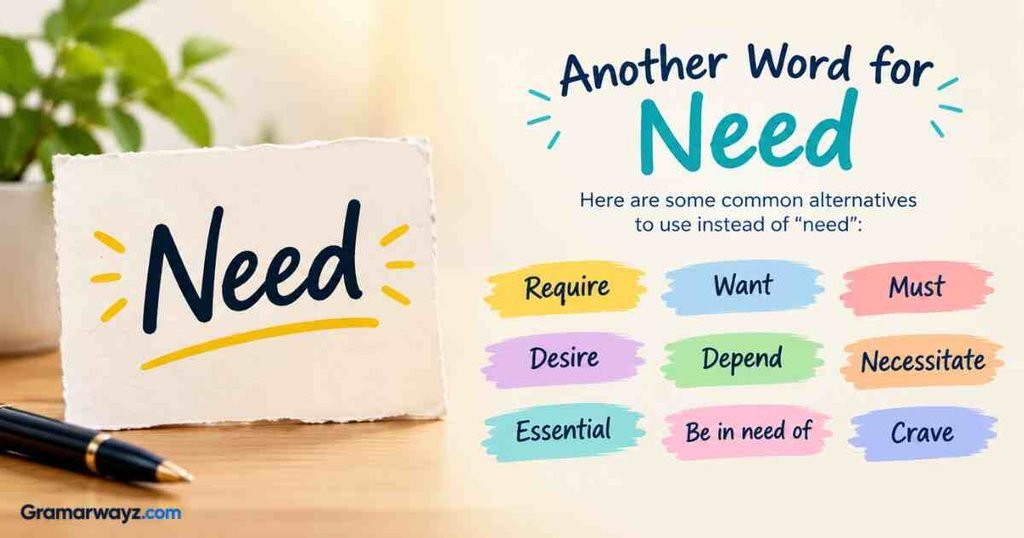

Choosing the right word for need can make your writing clearer, more natural, and more precise. Whether you want to express necessity, desire, demand, or a lack of something important, the best alternative depends on your sentence and intended meaning.
Another word for need might be require, necessity, demand, want, or essential, but each option has a slightly different use. Some alternatives work better in formal writing, while others fit everyday conversations, professional communication, or creative writing.
In this guide, you’ll discover useful synonyms for need, their meanings, and examples that show how to use them correctly. You’ll also learn the difference between the noun and verb forms of need, helping you choose the right word for any situation.
Need at a Glance
The best alternative for need depends on whether you mean something necessary, something you want, or a situation that requires action. Words such as require, necessity, demand, and want can replace need in different contexts, but they do not always carry the same meaning. Understanding these differences helps you choose the most accurate word for everyday conversations, academic writing, and professional communication.
Here is a quick guide to common synonyms for need and when to use them:
- Require: When something is necessary or mandatory. Example: This job requires experience.
- Necessity: When referring to something essential. Example: Clean water is a basic necessity.
- Demand: When expressing a strong need or a firm request. Example: The situation demands immediate action.
- Want: When describing a desire rather than a requirement. Example: I want a new laptop.
- Essential: When something is extremely important or indispensable. Example: Sleep is essential for good health.
- Lack: When something is missing or unavailable. Example: The team lacks the resources to finish the project.
Remember that need can function as both a noun and a verb. For example, “There is a need for change” uses need as a noun, while “We need more time” uses it as a verb. Choosing an alternative that matches the sentence’s grammar and meaning will make your writing more precise and natural.
The Most Useful Alternatives to Need
Finding another word for need depends on the meaning you want to express. You might be describing something necessary, a strong desire, a formal obligation, or a situation that calls for action. The following alternatives explain the meaning and usage of each word, along with two examples to help you choose the right expression for your sentence.
Require
Require means to need something because it is necessary, expected, or essential for a particular purpose. It is commonly used in professional communication, instructions, academic writing, and everyday conversations. This verb is a useful alternative when something must be available or completed.
Examples:
- This position requires excellent communication skills.
- Plants require enough sunlight and water to grow.
Both examples describe something necessary for a specific result. Use require when you want to emphasize a condition, resource, or skill that must be present.
Necessity
Necessity is a noun that refers to something essential or a condition that makes something necessary. It is suitable for formal writing, practical discussions, and situations involving basic needs or important priorities.
Examples:
- Clean drinking water is a necessity for every community.
- Due to financial necessity, she decided to find a second job.
The first example describes something essential for life, while the second explains why a particular action became necessary. Use necessity when discussing an essential item, requirement, or compelling reason.
Demand
Demand refers to a strong need, an urgent requirement, or a firm request for something. It can describe situations that require immediate attention or circumstances in which someone expects a particular response. In business, it can also refer to how much people want a product or service.
Examples:
- The emergency demands immediate action.
- There is growing demand for affordable housing.
In the first sentence, demands means that the situation requires action. In the second, demand describes people’s desire for housing. Choose this alternative when emphasizing urgency, strong expectations, or market interest.
Need
Need itself can be the most appropriate word when you want to express that something is necessary, important, or required. It works as both a noun and a verb, making it useful in everyday speech and formal writing.
Examples:
- We need more time to complete the project.
- There is a growing need for affordable healthcare.
In the first example, need is a verb describing something necessary to complete a task. In the second, it is a noun referring to an important requirement. Sometimes, the clearest alternative to need is simply to keep the original word.
Requirement
Requirement is a noun that describes something that must be fulfilled, provided, or completed. It often appears in job applications, academic instructions, official documents, and technical guidelines. Unlike a general need, a requirement may be a specific condition that must be met.
Examples:
- A valid passport is a requirement for international travel.
- Meeting the minimum experience requirement is necessary for this position.
Both examples identify conditions that must be satisfied. Use requirement when you want to communicate a specific rule, qualification, or necessary condition rather than a general desire.
Essential
Essential is an adjective meaning absolutely necessary or extremely important. It is a useful alternative when describing something that cannot easily be ignored or removed without affecting an important outcome. It frequently appears in health, education, work, and daily life.
Examples:
- Regular exercise is essential for maintaining good health.
- Clear instructions are essential for completing the assignment correctly.
In these sentences, essential emphasizes the importance of exercise and clear instructions. Use it to describe something that is fundamental to a goal, process, or outcome.
Want
Want means to wish for, desire, or hope to have something. Unlike need, which often suggests necessity, want usually describes a preference or personal choice. This distinction makes it useful when discussing things people would like to have but can manage without.
Examples:
- I want a larger desk for my home office.
- She wants to learn another language.
The first sentence expresses a preference for a larger desk, while the second describes a personal goal. Use want when the focus is on preference rather than something essential for survival or completing a task.
Desire
Desire is a noun or verb that expresses a strong wish, ambition, or feeling of wanting something. It often sounds more formal than want and works well in personal writing, professional discussions, and descriptions of goals or motivations.
Examples:
- His desire to improve motivated him to practice every day.
- She desires greater independence in her professional life.
The first example uses desire as a noun, while the second uses it as a verb. Choose this word when you want to emphasize a person’s motivation, ambition, or strong personal wish.
Must-Have
Must-have describes something considered extremely useful, desirable, or necessary in a particular situation. It is commonly used in shopping, technology, fashion, travel, and lifestyle writing. Unlike essential, which often expresses objective necessity, must-have can reflect personal preferences or current trends.
Examples:
- A reliable internet connection is a must-have for remote workers.
- This lightweight jacket is a must-have for spring travel.
The first example highlights a practical requirement for remote work, while the second presents the jacket as a useful item. Use must-have in informal writing when emphasizing an item or feature worth having.
Obligation
Obligation is a noun referring to a duty, responsibility, or commitment that a person is expected or required to fulfill. It differs from need because it emphasizes what someone is responsible for doing rather than what is necessary to achieve a particular result.
Examples:
- Parents have an obligation to protect their children’s safety.
- She fulfilled her financial obligations before making another purchase.
Both examples describe responsibilities that someone is expected to meet. Use obligation when discussing duties, legal responsibilities, financial commitments, or moral expectations.
Depend On
Depend on means that something relies on another person, resource, or condition to function or succeed. It can replace expressions involving need when the main idea is reliance rather than a simple requirement.
Examples:
- The success of the project depends on effective teamwork.
- Young plants depend on regular watering to stay healthy.
The first example shows that project success relies on teamwork, while the second explains what young plants rely on for healthy growth. Use depend on when describing a connection between something needed and the result it supports.
Call For
Call for is a phrasal verb meaning to require, justify, or make a particular response necessary. It is especially useful when discussing decisions, challenging circumstances, and situations that demand a suitable action.
Examples:
- The unexpected delay calls for a revised schedule.
- This delicate fabric calls for careful washing.
In the first sentence, the delay makes a schedule change necessary. In the second, the fabric requires special care. Use call for when a situation or condition makes a particular action, response, or approach appropriate.
Be in Need Of
Be in need of is a phrase meaning to lack something necessary or to require help, attention, or improvement. It is often used when describing people, organizations, objects, or situations that need support or repair. The expression can sound more formal than simply saying need.
Examples:
- The old building is in need of major repairs.
- Several families in the community are in need of food and shelter.
The first example describes something that requires maintenance, while the second highlights people who lack essential resources. Use be in need of when emphasizing a shortage, a problem that requires attention, or a need for assistance.
More Ways to Express the Same Idea
There are many ways to express the idea of need without repeating the same word. The right alternative depends on whether you are talking about a necessary action, a personal preference, a shortage, or a responsibility. Words such as necessitate, warrant, necessitate, and be short of can communicate related ideas, but each fits a different sentence structure or situation.
Here are some additional alternatives to consider:
- Necessitate: To make something necessary. Example: The damage may necessitate a complete replacement.
- Warrant: To justify or make an action appropriate. Example: The evidence warrants further investigation.
- Be short of: To have less of something than is required. Example: We are short of staff this week.
- Lack: To be without something useful or necessary. Example: The report lacks sufficient detail.
- Have to: To be required to do something. Example: I have to submit the form today.
- Be required to: To be officially or formally obligated to do something. Example: Visitors are required to show identification.
These expressions help make your writing more specific. For instance, necessitate emphasizes a consequence, while be short of highlights a shortage. Choose the alternative that communicates your intended meaning rather than replacing need simply to avoid repetition.
Alternatives to Need by Meaning and Situation
The best synonym for need changes according to the situation. A word that works for an urgent problem may sound unnatural when describing a personal wish or a basic requirement. Understanding the context helps you select an alternative that communicates the right level of importance, urgency, or desire.
When a Situation Demands Action
When circumstances make an action necessary, alternatives such as call for, warrant, necessitate, and demand can express the idea more precisely than a general statement about need.
Examples:
- The sudden increase in expenses necessitates a review of the budget.
- The serious nature of the complaint warrants an immediate response.
In the first example, necessitates explains that the circumstances make a budget review necessary. In the second, warrants means that the complaint justifies a response.
Use these expressions when explaining why an action is necessary, especially in professional writing, reports, and formal discussions. For everyday situations, calls for is often a more conversational choice.
When Something Is Missing
When need refers to a shortage or the absence of something, lack, be short of, be without, and be in need of may communicate the idea more accurately.
Examples:
- The small business lacks the equipment needed to expand production.
- Our team is short of experienced volunteers for the event.
The first sentence identifies something that is absent, while the second describes having fewer people than necessary. Although lack and be short of are related, the latter often emphasizes an insufficient amount rather than complete absence.
These expressions are useful when discussing limited resources, missing information, staffing problems, or situations requiring assistance.
When Need Means Desire
Sometimes, need is used informally to express something a person strongly wants rather than something essential. In these situations, want, desire, wish for, and long for may be better alternatives.
Examples:
- She wants a quiet weekend away from her busy routine.
- He longs for an opportunity to explore a new career.
The first sentence expresses a preference, while the second suggests a deeper or stronger wish. Neither necessarily means that the person cannot manage without what they want.
Use want for everyday preferences, desire for a more formal tone, and long for when describing a strong emotional wish. This distinction helps prevent a personal preference from sounding like an absolute requirement.
When Something Is Essential or Required
When something must be available, completed, or fulfilled, consider be necessary, be essential, require, and be a prerequisite for. These expressions are especially useful for instructions, qualifications, safety guidance, and formal communication.
Examples:
- A valid license is a prerequisite for operating this vehicle.
- Careful planning is necessary to complete the project on time.
A prerequisite is something that must be satisfied before another activity or process can proceed. Necessary describes something needed for a particular purpose without necessarily suggesting that it is the only possible condition.
Choose essential when emphasizing great importance, require when describing a specific condition, and prerequisite when something must come first.
How Different Alternatives Change a Sentence
Replacing need with another word can change a sentence’s tone, emphasis, and meaning. Some alternatives describe an obligation, others express a desire, and some explain why an action is justified. The words may be related, but they are not always interchangeable.
Compare these examples:
| Original sentence | Alternative | How the meaning changes |
| We need more time. | We require more time. | Sounds more formal and emphasizes necessity. |
| I need a new phone. | I want a new phone. | Changes the focus from necessity to preference. |
| The situation needs attention. | The situation calls for attention. | Presents attention as an appropriate response. |
| She needs financial help. | She lacks financial resources. | Emphasizes the shortage rather than the help required. |
| The job needs experience. | The job requires experience. | Makes the qualification sound like a specific condition. |
| They need to act now. | They must act now. | Expresses a stronger sense of urgency or obligation. |
Before choosing a synonym, consider three things:
- Meaning: Are you describing a requirement, desire, shortage, or duty?
- Tone: Does the sentence need to sound conversational, formal, or urgent?
- Grammar: Does the replacement work naturally with the words that follow it?
A good alternative preserves the intended message while making the sentence more precise. Using a more sophisticated word does not automatically make writing better. Clarity should always come first.
Need as a Verb vs. Need as a Noun
The word need functions as both a verb and a noun. Recognizing the difference helps you choose suitable synonyms and build grammatically correct sentences.
Need as a verb
As a verb, need describes something a person or situation requires. It can be followed by a noun, a pronoun, or an infinitive phrase beginning with to.
Examples:
- We need additional information before making a decision.
- She needs to finish her assignment today.
Common verb alternatives include require, want, depend on, and have to. However, their meanings differ. For example, require emphasizes necessity, while want generally expresses desire.
Need as a noun
As a noun, need refers to a requirement, shortage, or condition in which something is necessary. It often appears with articles or in expressions such as a need for and in need of.
Examples:
- There is a need for better public transportation.
- The shelter provides food to people in need.
Noun alternatives include necessity, requirement, demand, and shortage, depending on the context.
Quick grammar tip: Use require when replacing the verb in a sentence such as “We need more staff.” Use requirement or necessity when replacing the noun in a sentence such as “This is a need.” The replacement must match the grammatical role of the original word.
Natural Collocations and Grammar Patterns
A collocation is a combination of words that commonly appear together. Learning natural word combinations helps you use alternatives to need more confidently in conversation, essays, emails, and professional documents.
Here are several useful patterns:
| Word or phrase | Common pattern | Example |
| Need | need + noun | We need additional supplies. |
| Require | require + noun | The task requires careful planning. |
| Need | need + to + verb | I need to call the office. |
| Have to | have to + base verb | We have to leave early. |
| Necessity | a necessity for + noun | Clean water is a necessity for life. |
| Requirement | requirement for + noun | Experience is a requirement for the position. |
| Demand | demand for + noun | Demand for housing has increased. |
| Desire | desire to + verb | She has a desire to learn. |
| Depend on | depend on + noun | Success depends on preparation. |
| Call for | call for + noun | The situation calls for caution. |
| In need of | in need of + noun | The house is in need of repairs. |
| Lack | lack + noun | The proposal lacks detail. |
Pay attention to the grammatical patterns around each word. For example, need to leave and have to leave are both natural, but require to leave is generally incorrect in ordinary English. You would usually say be required to leave instead.
Also distinguish between a need for something and a need to do something:
- There is a need for better communication.
- There is a need to communicate more clearly.
The first expression identifies what is necessary, while the second identifies an action that should be taken.
Similar Words That Are Not Always Interchangeable
Several words related to need overlap in meaning, but using them as direct replacements can change your message. Understanding their differences helps you avoid awkward phrasing and communicate more accurately.
| Words | Main difference | Example |
| Need vs. Want | Need suggests necessity; want usually expresses preference. | I need medication versus I want a new watch. |
| Require vs. Demand | Require describes a necessary condition; demand can suggest urgency or a firm request. | The role requires training versus The workers demand better conditions. |
| Necessity vs. Requirement | Necessity emphasizes something essential; requirement often describes a specific condition or rule. | Food is a necessity versus A permit is a requirement. |
| Essential vs. Important | Essential means necessary; important means having considerable value or significance. | Water is essential for survival versus The meeting is important. |
| Desire vs. Need | Desire expresses a wish; need emphasizes necessity. | She desires recognition versus She needs medical attention. |
| Obligation vs. Requirement | Obligation focuses on duty; requirement focuses on a condition that must be met. | Paying a debt is an obligation versus A degree is a job requirement. |
| Lack vs. Need | Lack describes an absence; need describes what is required or wanted. | The report lacks evidence versus The report needs more evidence. |
| Must vs. Need to | Both can express necessity, but must often sounds more forceful or direct. | You must follow the rules versus You need to follow the instructions. |
The main lesson is to choose a word based on its exact meaning, not just its similarity to need. In particular, want is not always a suitable replacement for need, and important does not always mean essential.
Natural Examples Using Alternatives to Need
Seeing synonyms in complete sentences makes it easier to understand how they work in everyday and professional situations. The following 12 examples show different ways to express necessity, desire, responsibility, and dependence without relying on the same word repeatedly.
- Require: The application requires proof of your current address.
- Necessity: Reliable transportation is a necessity for many rural residents.
- Demand: The unexpected crisis demands a quick and careful response.
- Want: I want to improve my writing skills this year.
- Requirement: A completed application is a requirement for admission.
- Essential: Good communication is essential for effective teamwork.
- Desire: Her desire to succeed encouraged her to keep learning.
- Must-have: A comfortable pair of shoes is a must-have for long walks.
- Obligation: Employees have an obligation to protect confidential information.
- Depend on: The final result will depend on the quality of the available data.
- Call for: The damaged roof calls for professional repairs.
- Be in need of: The community center is in need of new equipment.
These examples demonstrate that different alternatives serve different purposes. Require and requirement communicate conditions, desire and want express preferences, and obligation emphasizes responsibility. Meanwhile, depend on highlights reliance, and call for connects a situation to an appropriate response.
When editing your own writing, look at the complete sentence before selecting a replacement. The most natural synonym is the one that preserves your meaning and fits the grammar.
Opposite Words for Need
The opposite of need depends on whether you mean necessity, desire, shortage, or dependence. There is no single antonym that works in every sentence, but several words and expressions communicate contrasting ideas.
| Opposite or contrasting expression | Meaning | Example |
| Have enough | Possess a sufficient amount. | We have enough food for everyone. |
| Surplus | An amount greater than what is required. | The farm produced a surplus of grain. |
| Abundance | A plentiful supply of something. | The region has an abundance of natural resources. |
| Unnecessary | Not required or essential. | Additional paperwork is unnecessary. |
| Optional | Not compulsory; a matter of choice. | Attendance at the workshop is optional. |
| Self-sufficient | Able to meet one’s needs independently. | The household aims to become self-sufficient. |
| Independent | Not relying on someone or something else. | The department operates independently. |
| Content | Satisfied with what one has. | He is content with his current lifestyle. |
These terms express different kinds of contrast. Unnecessary is often the closest opposite when need means requirement. Have enough and surplus contrast with a shortage, while content can contrast with a desire for more.
For example, “We need more supplies” could become “We have enough supplies” if the shortage has been resolved. However, “I need to finish my work” does not have one direct antonym. You would need to change the sentence to express the opposite idea, such as “I have no further work to complete.”
Choose an opposite based on the original sentence’s meaning rather than treating every antonym as interchangeable.
Conlcusion
Choosing another word for need depends on the meaning, tone, and context of your sentence. Alternatives such as require, necessity, demand, want, desire, and essential help express different ideas, from basic requirements to personal preferences and urgent situations.
Understanding the difference between need as a verb and a noun also helps you use synonyms correctly. Some words describe obligations or shortages, while others highlight desires, responsibilities, or necessary actions. By learning their meanings, grammar patterns, and common collocations, you can make your writing clearer and more natural.
Before choosing a synonym, consider what you want to communicate and how the word fits your sentence. Save this guide for quick reference whenever you need the right word.
Key Insight
1. What is another word for need?
Another word for need is require, necessity, demand, essential, or requirement. The best choice depends on whether you mean something necessary, a condition to fulfill, or an urgent situation.
2. What is a synonym for need in formal writing?
Require, necessity, prerequisite, and requirement are useful alternatives in formal writing. For example, “The position requires relevant experience” sounds professional and clearly communicates a condition.
3. What is another word for need when expressing desire?
Want, desire, wish for, and long for can express a desire. Use want for everyday preferences and desire when you want a more formal tone.
4. What is the difference between need and require?
Need is a common word used in everyday situations, while require often emphasizes a specific condition or necessity. For example, “I need help” and “The job requires experience” demonstrate their different uses.
5. What is the opposite of need?
The opposite depends on the context. Unnecessary contrasts with something required, while have enough expresses the absence of a shortage. Surplus describes having more than is needed.
6. How can I use another word for need in a sentence?
Choose a synonym that matches your intended meaning and sentence structure. For example, use require for a necessary condition, want for a preference, and call for when a situation makes an action appropriate.

I am the admin of Gramarwayz.com. I create and curate helpful synonyms, alternative words, and other ways to say common words and phrases to help readers improve their vocabulary and writing skills.